
This page describes Chocolate Vine, Akebia quinata, its medicinal properties and place in folklore.
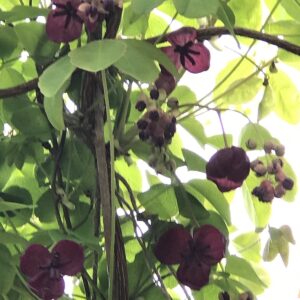 Akebia quinata is an attractive perennial climbing plant native to Far East countries, including China, Japan and Korea, but now found in gardens or as a naturalised plant across many countries of the world. Its scented brownish-purple flowers give it the common name Chocolate Vine. In suitable growing conditions these produce an edible fruit known in Japanese as Akebi, hence the first part of its botanical name. The second Latin word, quinata, means five-part, referring to its glossy divided leaves.
This image is of the vine growing over the arch in our Physic Garden, a photo taken in April 2021.
Introduced to Britain from China in 1845, by the plant hunter Robert Fortune*, this is a twining climber that needs support; and since it grows quickly, that support needs to be strong. The dangling, three-petalled, flowers appear in spring, and large fruits develop in late summer. The dark purple, oval, or sausage-shaped, fruits are full of seeds, similar to kiwi fruit, or Chinese gooseberry, (Actinidia deliciosa), to which the akebia is related. However, the flowers need cross-pollination by a different specimen to produce fruit, and their development is also dependent on hot summer weather.
NOTE: In the USA, Australia and New Zealand this pretty ornamental is regarded as a pest. It is an invasive non-native plant that has naturalised widely, sometimes smothering native plants and even woodland. Gardeners therefore need to be aware of its vigour, and the fact that the plant can propagate from leaves and stems fallen to the ground, as well as from seed. It will venture into your neighbour’s garden too, if not managed properly. Left to grow unchecked it can attain 12 metres in height; and if unsupported it happily turns into dense ground-cover, the attractive flowers almost invisible among the tangled leafy growth.
*A brief description of Robert Fortune and his work can be found on our page about Winter Jasmine.
Medicinal Uses
This is a plant with thousands of years of medicinal history in China and other East Asian countries, where it is considered effective in a wide number of applications.
It has diuretic, anti-inflammatory, anti-rheumatic and analgesic (pain-killing) properties, as well as inducing sweating and bringing down fever. It is taken internally for stomach and kidney ailments, infections of the urinary tract, and other digestive tract conditions. Women take it for menstrual pain and related problems, and it is recommended as a stimulant for milk production in nursing mothers. It is also prescribed for colds and headaches, and as a general tonic.
Therapeutic preparations are often made from the dried woody stem of the plant, but the fruit and roots can also be used.
Culinary Uses
The pulp of the fruit can be eaten raw. It is sweet, although some writers think it lacks flavour, including a Japanese chef who, ten years ago, started to research this fruit (not then commonly eaten by many of his compatriots). The Japanese do not usually care for fruits full of seeds, and spit them out or remove them first. However, Akebi fruits are now being grown in Japan as a commercial crop.
Lemon juice may be added to flavour the raw pulp, or it can be pureed to make a smoothie-style drink, with a taste that has been compared to the flavour of coconut milk. The fruit can also be used in wine-making.
The skin of the raw fruit is bitter, but once the pulp is removed the pods are often stuffed and deep fried.
The seeds are in fact perfectly edible, and they may be processed to make a cooking oil.
Akebis are high in protein and vitamin C, and an academic article published in 2010 in the journal Hortscience explored these properties further, under the title A potential new fruit crop in China.
Other uses
Extracts of Akebia are used in the production of skin creams and moisturisers, including ‘anti-ageing’ products and those used to reduce scarring after surgery. Recent research has shown positive results using Akebia quinata fruit extracts in such products.
The stems, peeled, are very flexible and are woven into baskets. The oil from the seeds can be used to make soap.
Myth and Magic
Apparently known as ‘wild bananas’ in China, the wild fruit crack or split open of their own accord when ripe. This usually happens in August, so the fruit was also locally known by a Chinese name that translates as ‘August Crack’. (Cultivated akebis do not burst this way – they have to be cut open to get out the pulp).
In one region of Japan, people believed that their ancestors’ spirits returned to earth on a ship made from the pod of the akebi; and they made offerings to Buddha of the fruit.
A Japanese manga series has a heroine named Akebi, but I have not so far been able to find out the relevance to our current context…
Acknowledgments – thanks to the following for much information
www.practicalplants.org
www.eattheweeds.com
www.thespruce.com
www.gardenersworld.com
www.elmaskincare.com
www.cosmeticsbusiness.com
www.ncbi.nlm.nih.gov
www.myanimelist.net
www.journals.ashs.org