
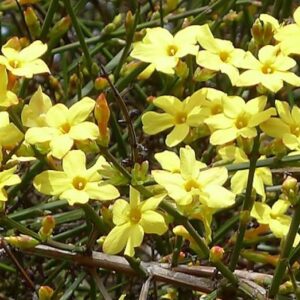
 Read here about Winter Jasmine, Jasminum nudiflorum, and the plant hunter who introduced it to Britain.
Winter Jasmine is a popular winter-flowering shrub in British gardens, bringing a bright burst of yellow at a time when most other plants are dormant. It is a native of China and Tibet, an area rich in beautiful and now familiar plants including roses, azaleas and chrysanthemums.
Many of these, like Jasmine, were introduced to European gardens in Victorian times. Robert Fortune, who worked for the Royal Horticultural Society as their official ‘Collector’ in China from 1843-46, was responsible for the introduction of Jasmine to Britain.
[See below].
There are several species of jasmine, all of which produce small star-shaped blooms, often in clusters, that are mostly pale pink, white or cream. Winter Jasmine is one of a few that produce bright yellow flowers, which appear on the bare, dark green stems before its leaves: hence the botanical name nudiflorum. Winter Jasmine is fairly hardy in the UK, growing well in most soils and, while flourishing in sunshine, also tolerates shade. Apparently it does not set seed in the UK because all plants are descended from the specimen originally introduced. My source for this was a book written in 1922, so I am open to correction.
Unlike some jasmine species, including the highly scented house-plant Jasmine (Jasminum polyanthum) that is often sold twined around a trellis, Winter Jasmine has little or no scent, and does not twine: instead it sends out strong vertical or arching stems, reaching 5ft /1.5metres. These, like the shoots of rambling roses, can be trained and supported to cover a fence or wall.
We grow Winter Jasmine as an ornamental in the Physic Garden, but it has no medicinal properties unlike its near relative, Common Jasmine (Jasminum officinale). However, its bright sunny yellow flowers, appearing in the dark dim days of winter, certainly lift the spirits and act as a tonic – just what the doctor ordered?
Jasminum officinale information can be found here. Also known as Summer Jasmine, it is equally hardy in the UK, and is famed for its heady summer perfume, and its medicinal benefits.
Robert Fortune, Plant Hunter
Robert Fortune, a Scot who started his horticultural career at the Botanic Garden in Edinburgh, was very successful in his profession, introducing more than 120 different species to western gardens from China and Japan, and some of these were later given the botanical name fortuneii in his honour. He had many adventures in China, travelling into regions that other Europeans had rarely, if ever, seen, encountering storms and piracy, and sometimes fierce local opposition. He learned Mandarin and even disguised himself in local dress to avoid detection. Working on behalf of the East India Company, he illegally shipped thousands of tea plants from China to India for the company’s plantations. As well as his physical introduction of many new specimen plants to Europe, he gained experience of the silk industry and rice growing, and this, together with his knowledge of the techniques of tea production, contributed to his reputation. He also wrote several books about his travels.
We no longer consider his methods appropriate, in uprooting specimens and smuggling them out of the country: we even have laws in the UK to protect our own native species. But just as the Victorians would happily ‘dig’ in other countries and carry away the archaeological treasures to fill their stately homes and museums, so they saw nothing wrong in sending out plant hunters like Fortune to bring back as many exotic plants as they could, by whatever means.
Acknowledgements Thanks to the following for much information
www.bugwomanlondon.com
www.pfaf.org
www.mygarden.org
www.rhs.org.uk
www.plantexplorers.com