
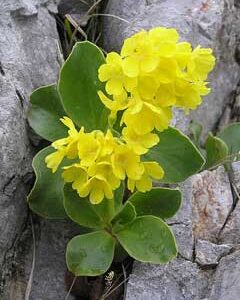
 Primula auricula is an evergreen or semi-evergreen herbaceous perennial, with rosettes of pale green leaves above which are borne umbels of yellow flowers on stems that can reach 20cm in height. Also known as Mountain Cowslip or Bear’s Ear, this is the European alpine wild flower.
The Auricula growing in the Physic Garden is one of many hundreds of garden varieties. These developed from a natural cross between Primula auricula and Primula hirsuta, both being native to the Alps and other European mountainous regions. These descendants are generally known as Garden Auriculas to distinguish them from the original wild flower.
Gardeners, and many nurseries, also use the simple common name Auricula, or Auricula Primrose, or Bears Ears (derived from the shape of the leaf, as is the word auricula itself, the Latin for ear). The hybrid nature of the plant is, however, revealed by several versions of the botanical name: Primula pubescens or Primula x pubescens or Primula auricula x pubescens.
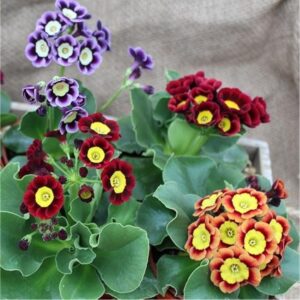 Plant breeding, over 400 years, has produced the many types and quality of flower we see today. They are easy to grow, easy to propagate, and appeal both to the owners of large estate gardens and those with limited space and means who appreciate their vibrant and varied colours. Being the subject of passionate devotion from the ‘auricula fancy’, new forms constantly appear in nurseries and at specialist flower shows, giving the enthusiast an almost endless selection.
Auriculas were grown in Britain from Elizabethan times, but they began to attract the notice of serious gardeners in the 17th century. In 1665, John Rea, a nursery gardener and writer from Shropshire, referred to Bears Ears as being ‘nobler’ types of cowslip, and mentioned that gardeners valued them for their variety of colour, shape and size. Oxford Botanic Garden recorded nine differently-coloured specimens in 1658, but in the 18th and 19th centuries hundreds of varieties were produced. Many were artificially hybridised, but some arose from natural mutations, including a prized green colouration, and the ‘mealy’ central ring that is now the defining characteristic of a specific group of auriculas.
In the 19th century, plant hunters’ introduction to Britain of new plant species was accompanied by an enthusiasm for developing new varieties of known plants. The National Auricula and Primula Society, www.auriculaandprimula.org.uk , was set up in Victorian times, and the northern branch, founded in 1873, is celebrating its 150th anniversary this year.
There are two main groups recognised by the society: Show Auriculas, and Alpine Auriculas. To the novice, the main difference is that the dusty or floury appearance at the centre of Show plants, caused by a white waxy substance known as farina, is missing from the Alpines. This central ‘eye’ in show plants is called ‘paste’, having the appearance of unglazed porcelain.
Auriculas are hardy, but while other rockery or alpine plants are happy in thin gritty soils, auriculas need well-drained humus, and should be protected from hot summer sun. Whether in a rockery like ours in the Physic Garden, in woodland borders, in garden pots, or displayed in elaborate ‘theatres’, their jewel-like colours and varied forms are an excellent addition to any garden.
Medicinal Uses
As a member of the same Primulaceae family, the auricula shares many properties with the Primrose and Cowslip, but its known medicinal uses are limited to treatment for coughs and headaches. Research is ongoing, into several plants of the Primulaceae family, as to their potential pharmaceutical value.
WARNING
Auriculas are not considered edible, although toxicity to humans is low. However, devouring Auricula leaves or flowers can cause intestinal distress or vomiting to pet animals such as dogs, cats, horses and tortoises.
Myth and Magic
The common name Bear’s Ear is not exactly magical but why it was chosen is as mysterious as any myth. I recently bought a ‘vintage’ book, called simply ‘Auriculas’, in which the author, Roy Genders, tackled the naming of the plant. Apparently it went by this ursine nickname from its first introduction to Britain during the late 16th century: its botanical name from the 15th century had been Primula ursi , so the bear-connection was already in use. Mr Genders came up with two possible explanations. One was that the leaf-guard, which folds over the flower, eventually opens into something resembling an ear, though not particularly that of a bear. Alternatively, was it a reference to the large hairy leaves of some varieties? Mr Genders’ own preferred English name was that given by a 17th century writer: the French Cowslip; or that used by John Gerard, i.e. English Garden Cowslip.
One of the most magical things about Auriculas is their enormous variety; and the ability of even amateur gardeners to add to the vast range of Show Auriculas. This magic is often displayed in ‘Auricula Theatres” – shelves of individual pots of plants set out in rows.
This practice, according to the New York Botanic 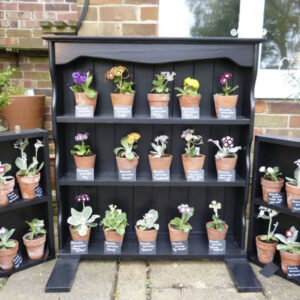 Garden, started in France and Belgium in the 17th century, but became the display method of choice in 19th century Britain. At this time, both fashionable grand estates and the small back gardens of coal miners were displaying auriculas in theatres ranging from small and simple to large and elaborate.
It may be of interest to note that Carl Linnaeus, the botanist who gave us many of our modern plant names, was dismissive of the development of so many different varieties from the wild plant, considering such plant breeding not worthy of the attention of the true botanist. His loss, we feel.
Acknowledgments – thanks to the following for much of this information
www.plant-fairs.co.uk for the photo of Swallowfield’s Nursery Auricula Theatre
www.gardeningexpress.co.uk for the photo of Primula pubescens Auricula
Auriculas by Roy Genders, published for the Gardening Book Club in 1958