
Read here about the common Primrose, (Primula vulgaris), its medicinal properties and place in folklore.
The Common Primrose, the pale yellow ‘fragrant messenger of spring’ as Coleridge put it, is native to the British Isles, its most common name meaning ‘early rose’, being one of the first spring flowers to bloom. Common names found in different parts of the UK include golden rose, Lent rose, Easter rose, and butter rose. Many wild flowers that are not in the rose family bear the name, as a sort of generic name for an attractive flower; but in this case the resemblance is most obvious in the form of its five delicate petals.
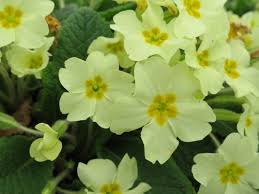
A hardy perennial, the primrose is pollinated by bees, moths and butterflies, readily grows in different soils and tolerates frost. A common sight on road and railway verges, woodland clearings, hedge-banks and even open fields, we can now add them to our gardens by buying native-grown plants from reputable stockists. There are also many garden varieties, including one that resembles it very closely except in its rich purple colour and is often given ‘primula’ as a common name to distinguish it from the yellow variety, having escaped the garden to become prolific in some areas. There are many cultivars in every possible colour and shade, available in nurseries and garden centres.
Near relatives are Cowslip (Primula veris), with clusters of blooms on each stalk; and Oxlip (Primula eliator), now rare in the wild in the UK, and mostly confined to East Anglia.
Medicinal Uses
Primroses, along with cowslips, have a long history of medicinal use. Extracts, infusions and other preparations were derived from their leaves, flowers and roots in medieval and earlier medicine, and prescribed for ailments ranging from headache to skin lesions, from coughs to rheumatism, as emetics and to reduce fever. They were also believed to be especially useful for spasms, cramps, and paralysis.
The roots, like those of the cowslip, were used in treatments for bronchial problems, as an expectorant. The leaves and flowers were included in remedies to produce sweat during a fever, and to act as a diuretic. The plant has also been used to rid the body of intestinal worms.
It has been suggested that boiling the whole plant including the flowers will make a sedative. John Gerard, the 16th century herbalist, believed that “Primrose tea drunk in the month of May is famous for curing the phrenzies.” A more modern reference states that, in the 1990s, students of herbal medicine “were taught that an infusion of the flowers will help the insomniac to drop off to sleep“.
A century later, Nicolas Culpeper wrote “Of the leaves of Primrose is made as fine a salve to heal wounds as any I know.” Modern herbalists may also recommend the application of a primrose leaf poultice for a wound. In addition, they may prescribe it for rheumatic pain, to bring on a sweat, for bronchial coughs and as a diuretic.
Scientific research has found that the plant contains saponins, which have an expectorant effect, and salicylates. The latter are the main ingredient of aspirin, and thus primrose medication may be expected to produce similar remedial effects.
WARNING: Pregnant women, people sensitive to aspirin, or those taking anti-coagulant drugs such as warfarin, are advised against medicines containing primrose.
Culinary Uses
Young leaves, either raw or cooked as a potherb, can be added to soups and stews, but they have a very mild flavour and the texture is rather tough. They can also be made into a syrup, or used like other leaves for a pleasant ‘herbal’ tea.
The flowers may also be eaten raw or cooked, and in particular make an attractive garnish to salads. They are added to conserves or cooked with vegetables, and may also be made into a syrup or tea.
Primroses have also long been used by country folk to make alcoholic drinks, along with such equally unlikely examples as nettle and parsnip. For primrose ‘wine’, the flowers were picked at first opening, fermented with water and sugar, and bottled.
Myth and Magic
The Romans held that primroses were given to the earth in memory of a son of the goddess Flora, while Celtic peoples believed the flower to be sacred, representing renewal and the return of abundance. The flower’s association with Brigid, the goddess of rebirth, was modified in Christian times by linking it with St Bride. Bunches of primroses were offered to her on 1st February, the date also of the pagan festival Imbolc.
Welsh stories tell of Olwen, the May Queen, who was made out of flowers, one of them being the primrose. It is also unsurprisingly associated with the ‘faerie’ people, particularly in Ireland.
A more prosaic, and true, story hangs on the unusual association of the native primrose with the Conservative party. It is difficult to imagine this delicate-looking flower being chosen to remind us of a Prime Minister, but apparently it was Benjamin Disraeli’s favourite and Queen Victoria sent a wreath of primroses to his funeral. He died in 1881 on 19thApril and that day remains ‘Primrose Day’. At the subsequent unveiling of his statue, all the MPs present wore a primrose buttonhole; and a group of Conservatives formed the Primrose League shortly after ‘to uphold the Conservative cause’ and to spread the Conservative values of the day, such as promoting free enterprise and maintaining the power of the Empire. There was a Ladies’ Council from the earliest years of the organisation, and during the fight for women’s suffrage this helped to make respectable the idea of women in politics. However, the League declined in the late 20th century, and was wound up finally in 2004.
Acknowledgements Thanks to the following for much of this information
www.naturalmedicinalherbs.net
www.theecologist.org
www.plantlife.org.uk
www.britishempire.co.uk
www.myfanwycook.com
www.gracelikestogarden.com
www.gardenflowerhistories.wordpress.com
www.wightdruids.com
www.herbs-treatandtaste.blogspot.co.uk
www.botanicamedica.co.uk