
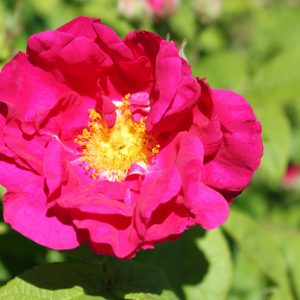
 The Apothecary’s Rose, Rosa gallica var officinalis, is known by British gardeners as an Old Rose, meaning it is a descendant of the oldest roses known to have been cultivated in Europe. The Ancient Greeks and Romans domesticated them from wild roses growing in central and eastern Europe and western Asia.
Gallica is only one class of the true Old Roses, the others being Damask, Alba, Centifolia and Moss. All Old Roses generally flower for a short season, usually in early summer, and do not repeat flower later; but the blooms are usually very fragrant and abundant. Gallica roses are also quite hardy, cold tolerant and disease-resistant; and, like all roses, they are attractive to many pollinators.
The Apothecary’s Rose has been known from at least the 13th century; and it is thought that the Red Rose badge of the Royal House of Lancaster, adopted in the 14th century, was based on that particular rose. It is a low-growing shrub rose with large, fragrant blooms of deep purplish-red, a colour shade sometimes described as fuchsia. (A variant bearing petals of the same colour striped or ‘splashed’ with white is known as Rosa Mundi, Rosa gallica versicolor.)
Medicinal Uses – not specific to Rosa Gallica
Roses have been used in traditional medicine for millennia, and it is known, for example, that the Ancient Romans marinated them in wine as a hang-over cure.
Avicenna, the great physician and polymath born in Persia in 980 AD, author of The Canon of Medicine and The Book of Healing, described how he distilled rose water for his medicines. He used roses in remedies for eye diseases, fainting, and heart palpitations, as well as other conditions.
In documents listing the inventories of three 16th century Scottish apothecaries, held in Scottish museums, it is noted that all of them stocked conserve of roses.
The 17th century physician and botanist John Gerard described many different roses in his Herball, but his account of their uses in medicine fell under a general heading, “The Vertues,” i.e. the useful properties of all roses. Gerard also mentioned several different ways to make use of the rose: juice, infusion, syrup, distilled rosewater, candied leaves.
Roses have been used in a wide range of applications: to relieve indigestion and stomach ulcers; as a gentle purgative; to soothe skin rashes and wounds; to cure sore throats; and to reduce fever and inflammation. The juice was prescribed to soothe inflamed eyes and to aid sleep, and the scent of the rose itself was believed to improve sleep. Rose preparations were also recommended for the ‘refreshing of the spirits’ and ‘strengthening of the heart’ – or, as we might say, to counter depression and anxiety.
Along with Apothecary’s Rose, we grow others in the Physic Garden, including Hedging Rose and Dog Rose: follow those links for more information about the medicinal and other uses of the Rose, both specific and general.
Other Uses
The essential oil of rose is used in aromatherapy and similar treatments, and as an ingredient in soaps, lotions and creams for hygienic and cosmetic purposes. Rose essential oil is expensive, as well over a million blooms are required in the production of each kilogram of oil.
Rose petals are also used in various culinary applications, including being candied as sweets or decorations, and steeped to make a flavouring for drinks. At the Secret Garden Distillery, in Edinburgh, for example, they have a large garden of Apothecary Roses, whose petals are harvested to flavour and colour gin.
Myth and Magic
Roses have long played a part in a variety of human activities beyond their presence in the garden: from medicines to magic, from confectionery to cosmetics, art and architecture, legend and literature. They appear as motifs and symbols in fields as varied as religion, heraldry and fashion. It is probably safe to say that the rose surpasses all other flowering plants in its ubiquitous presence in myth, legend, romance, poetry and song, fact and fiction, spiritual and profane. I shall not attempt the impossible here, but refer simply to a couple of examples.
Rosa gallica versicolor
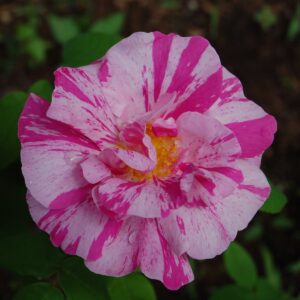 It is also almost impossible to isolate stories about any specific rose groups, let alone individual cultivars, but here is one. The common name of that lovely red and white rose is Rosa Mundi. This means Rose of the World – not indicating that it has a global presence, but that it is a rose tainted by worldliness, as opposed to a pure rose, which in Latin would be Rosa Munda. One story goes that this phrase referred to Rosamund Clifford, the acknowledged mistress of Henry II, who was often known as Fair Rosamund.
It is said that a rhyming epitaph was inscribed on her tomb:
Hic jacet in tumba Rosamundi, non Rosamunda, Non redolet sed olet, quae redolere solet.
Here in the tomb lies a worldly rose, not a pure rose; she who used to smell sweet, still smells – but not so sweetly.
The Rose in Heraldry
The Tudor Rose is possibly the most familiar heraldic device in the UK, certainly in England, and was created by merging the red rose of the House of Lancaster and the white rose of the House of York. It was possibly the first ‘double’ rose in heraldry, placing one rose within another, leading to ten petals rather than the usual five.
King Edward I of England had a gold rose on his badge, so his brother Edmund, the Earl of Lancaster, used a red rose instead, from which is derived the red rose of Lancaster. There is no real evidence that the device was actually used during that long-running 15th century power struggle between two noble families and their allies. Even the name Wars of the Roses was not invented until the 19th century: the phrase was devised by the novelist Sir Walter Scott.
Why “The Apothecary’s Rose”?
The story goes that, in Napoleon’s time, French apothecaries placed a gallica rose in a pot at the door of their shops, and in time it became the recognised symbol of their profession. So what exactly is an Apothecary?
An apothecary was someone who not only dispensed medicines but also created them. The word itself derives from the Greek apotheke, meaning a storage place or warehouse; and the word in English gradually narrowed in meaning to refer to a specific type of store, one where wine, herbs and spices were kept. In Britain, by the 13th century, the word apothecary came to be used also for the person who kept the store and sold the goods from it.
At that period, apothecaries were seen as a type of grocer, i.e. a merchant trading in dried and preserved foodstuffs, and so they belonged to the same medieval guilds.
Over time their role changed from merely selling ingredients to creating and dispensing a wide range of herbal medicines, and they campaigned for separate recognition. In 1617, James I granted them a royal charter, creating the Worshipful Society of Apothecaries, with their own dedicated Hall. These premises were destroyed by the Great Fire of London, but they rebuilt them on the same site; and remained there, producing and selling medicines and associated products, from 1672 until 1922.
Of particular interest to the team at the Congleton Bath House & Physic Garden, it was this society that founded the famous Chelsea Physic Garden in 1673, which is still going after 350 years.
Acknowledgments – thanks to the following for much of this information
www.davidaustinroses.co.uk
www.gobotany.nativeplanttrust.org
www.mms.org
www.secretgardendistillery.co.uk
www.nts.org.uk
www.dukeperformance.duke.edu
www.rosesforenglishgardens.blogspot.com
www.mossbotanicals.com
www.hallofnames.org.uk
The image of the Rosa Mundi – www.dengarden.com