
This page is about the Hedging Rose, Rosa rugosa, its medicinal and other properties and place in folklore.
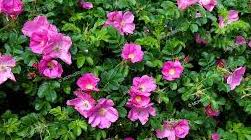
Rosa rugosa is a species of rose native to eastern Asia, in north-eastern China, Japan, Korea and south-eastern Siberia. In the latter regions it is sometimes known as Beach Rose, from its local habitat. It is also referred to as the Japanese Rose, although other roses also bear this common name; and Hedgehog Rose, because of the very prickly stems that make it popular for hedging. Originally introduced as an ornamental garden species, it has escaped into the wild, and is now found in many parts of Europe, and is even considered invasive in North America. In the UK it is a popular garden and hedging species.
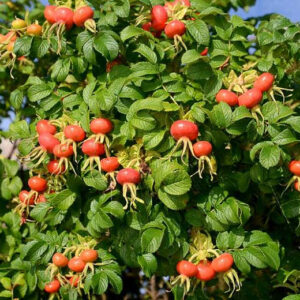 The large, pleasantly scented, flowers can be white, bright pink or a deep purple-red. Later these blooms give rise to vivid red fruits, known as hips, the largest of any rose-hips found wild in Britain, shown in the image here.
(The most familiar genuinely wild, or native, rose found in Britain is the Dog Rose (Rosa canina). A thorny, scrambling, climber with pink or white lightly-scented flowers, the dog rose has hooked prickles, helping it cling to the shrubs and trees supporting its vigorous growth.)
Medicinal Uses
Many cultures, ancient and modern, including Greeks, Persians, Romans and the Chinese, are known to have used roses medicinally. A wide range of uses included treating chest infection and coughs, as a laxative or as a diuretic, to soothe gastric upset, and in cases of fever. Pliny, in 77AD, listed thirty conditions he claimed could be cured by medicines derived from roses.
In Chinese medicine, rose buds are the part commonly used for medicinal purposes, and specifically the buds of Rosa rugosa, known in China as Mei Gui Ha. They are picked just before they open, and dried at a low temperature. They are used by Chinese herbalists to treat a number of gynaecological disorders; for conditions of the liver; and more recently for depressive illness.
Natural medicine practitioners also suggest:
– The leaves to treat fevers
– The flowers for poor appetite and digestion, and for menstrual complaints
– The root as a treatment for coughs
No current clinical evidence is available for these medicinal purposes. There has been some research into their possible use as a food capable of reducing the incidence of cancer; and also as a means of halting or reversing the growth of cancers.
Myth and Magic
In Ancient Greek and Roman mythology, roses were considered representative of love and beauty. One story tells of Chloris, goddess of flowers and springtime, who, coming across the lifeless body of a woodland nymph, decided to bring her back to life as a flower, with the help of the other gods. Between them they created a veritable “Queen of Flowers”, which Aphrodite, goddess of beauty, named Rose, and dedicated to her son Eros, god of love.
Jews, Christians and Muslims have all seen the rose as a symbol for love: the bloom for the evident pleasures, the thorns for the hidden pains. In Christian symbolism, as seen in paintings, stained glass and poetry from the middle ages, throughout the Renaissance and into Victorian and Pre-Raphaelite works, the rose is often a symbol for Mary, the mother of Christ, and even for Christ himself. The red rose is the blood of Christ, the white rose the purity of his mother.
The five-petalled rose was a common device in medieval heraldry, and can be found in the UK particularly in the familiar Tudor Rose emblem, a symbol used widely, whether for heraldic or decorative purposes, from architecture to textiles to garden design. A central motif in the British monarch’s regalia from Henry VII to the present day, it has a less royal connotation in Germany where it is linked to the Devil and its fruits were said to be used by fairies to make themselves invisible!
Acknowledgments Information gratefully sourced from the following:
www.chineseherbshealing.com
www.permaculture.co.uk
www.rhs.org.uk
www.drugs.com
www.practicalplants.org
www.naturalmedicinalherbs.net
www.woodlandtrust.org.uk
www.charentonmacerations.com