
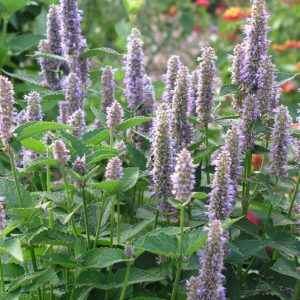
 Anise Hyssop, Agastache foeniculum, is native to Western North America but has long been introduced elsewhere, and flourishes in UK gardens. It has become a popular plant, grown for its attractive flowers and for use as a culinary and medicinal herb.
The common name Anise Hyssop is rather misleading. It is not a close relative of the well-known European native herb Hyssop, Hyssopus officinalis, although they are both members of the large Mint family Lamiaceae. It is not related to Anise at all: Anise, Pimpinella anisum, is a member of the Carrot family, Apiaceae.
The native plant has other common names – Blue Giant Hyssop, Lavender Giant Hyssop, for example – but there are also several garden cultivars. Easy to grow in most soil types, in containers or in borders, this drought-tolerant perennial thrives in full sun. Spikes of lavender-purple flowers form clumps that can grow to 4ft (120cm), and dead-heading encourages a long flowering season, from June/July to September. They are attractive to pollinators including butterflies and bees, while the nettle-like leaves are very aromatic, with a scent reminiscent of liquorice or aniseed.
Medicinal uses
Anise Hyssop was long known by Native Americans for its medicinal properties, and it could be used as a poultice, applied to burns, or as a tea. The latter was particularly helpful in relieving coughs and other symptoms of colds; and was also prescribed as a tonic for the heart.
Modern herbalists still recommend anise hyssop for respiratory symptoms, to clear mucus and to reduce chest pain. Remedies may be derived from the essential oil of the plant, or by using the leaves both externally and internally. Applications include treatments for inflammation and other conditions of the urinary and gastrointestinal tracts; and as a salve for sunburn and athlete’s foot.
Scientific research confirms that the plant has a high level of antioxidants; and many studies have been made into its potential antimicrobial and cytotoxic (anti-cancer) properties. One laboratory study produced evidence that flavonoids and other compounds, found specifically in the leaves, are active in mitigating the effects of ageing, thus leading to better health and longer life. Further work is needed in this area.
Culinary uses
Both leaves and flowers are edible, and can be used as a decorative addition to salads and summer fruit drinks. The leaves can be chopped as a cooking herb into savoury rice and egg dishes; sprinkled on new potatoes as a change from mint or chives; and are particularly good as an accompaniment to pork.
Anise Hyssop herbal tea, made from the leaves, is well-known, but the flowers can also be used (recommended by one writer as a hang-over cure). Infuse them in boiling water to make a simple tisane.
Myth and Magic
As an introduced plant, anise hyssop has created no UK-local folklore; but in its native North America the Chippewa used it as a protective charm.
It can also be used in a ‘smudge stick’: dried herbs are bound into a bundle, set alight, and then allowed to smoulder, resulting in an aromatic smoke. For several groups of native American peoples, this formed part of a spirit-cleansing ceremony, and traditionally White Sage, a herb sacred to those peoples, was used.
Smudge sticks have been popularised widely, and used in non-religious alternative therapy practice; in modern witch-craft rituals; and more prosaically taking the place of incense burners and similar air-freshening products. There is now some controversy about the commercial adoption of a religious artefact, and one writer on herbal topics suggests a sustainable and ethical alternative. She has successfully created similar sticks from a selection of pleasant aromatic herbs growing in her own garden, and points out that anise hyssop is an ideal choice when making them.
Acknowledgments – thanks to the following for much of this information
www.piedmontmastergardeners.org
https://www.ncbi.nlm.nih.gov for a scientific research paper on the potential pharmaceutical properties of anise hyssop