
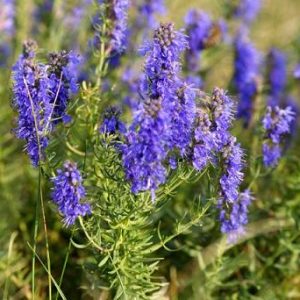
Hyssop, Hyssopus officinalis, is a native plant from southern Europe and the Middle East that has spread widely throughout Europe and been introduced into North America. A member of the huge Mint plant family, Lamiaceae, it has many of this family’s characteristics, especially the strongly scented leaves.
Hyssop is an upright, shrub-like, semi-evergreen plant. Its blue flowering head spikes rise, from summer to early autumn, on stems bearing short, aromatic, spear-like leaves.
It was very popular as a culinary herb in the medieval period, and in 1652 Nicolas Culpeper wrote, “ Hyssop is so well known to be an inhabitant in every garden, that it will save me labour in writing a description thereof”. However, it is nowadays less common as a ‘herb’, and more likely to be found in the flower garden. The flowers are attractive to many pollinators, including bees, and bee-keepers say the honey produced is excellent.
Hyssop grows well in moist, well-drained soil in full sun; and, while it can be grown in a pot, it is an excellent addition to the mix in a rock garden or herbaceous border. It does need plenty of water until it is firmly established, but it will then be drought tolerant. And, unlike some of its relations, it is not overly invasive.
Medicinal uses
Hyssop has a long medicinal history in its native lands. Its leaves were steeped to make a tisane (herbal tea) for relief of the symptoms of coughs and colds. Ointments could also be made from the leaves and were used for wounds, infections and other skin ailments.
The ancient Persians made a lotion from the oil to improve skin health; and the essential oil, now known to have antibacterial, antiseptic and antifungal properties, is still used in preparations for a range of conditions.
Medieval medical practitioners in Europe, including Britain, held the herb in high esteem. Culpeper, in the passage on hyssop mentioned earlier, said that hyssop mixed with wine was an excellent treatment for inflammation, and mixed with water should be used to reduce bruises and scars. He also recommended hyssop oil to remove head lice; and described preparations of hyssop that would deal with ear-ache, sore and swollen throats, headache, coughs and colds, fresh wounds, and even cure snakebite. He also referred to the ancient Greek physician Dioscorides, who suggested boiling hyssop to make a medicinal potion, mixing it with honey to treat intestinal worms; with rue and honey for respiratory problems; and with oxymel (a vinegar and honey concoction) to ease constipation.
Contemporary herbal medicine also makes wide use of hyssop. It is prescribed to alleviate gastrointestinal discomfort; reduce respiratory inflammation and asthma symptoms; manage symptoms of the common cold and act as an expectorant; treat colic; and counter loss of appetite.
Modern scientific research has identified compounds in hyssop that are extremely important for good human health, including antioxidants and flavonoids. The latter in particular may reduce the risk of several age-related conditions, including cataracts, heart disease and strokes.
Many studies now also confirm traditional medicinal applications in areas such as inflammation and asthma. Research also suggests that it may assist in reducing the risk of cancer, arthritis, ulcers and diabetes. More studies are needed to substantiate these theories in order to produce practical outcomes.
WARNING
Hyssop, and products containing hyssop, should not be taken by:
– pregnant, or potentially pregnant, women, as it can cause miscarriage;
– anyone taking anti-seizure medication;
– people with diagnosed seizure disorders; and
– children, as they are more susceptible to the seizure effect.
Culinary uses
Hyssop has largely declined as a cooking herb since the Middle Ages when it was widely used to flavour stuffings and soups, for example. The strongly flavoured leaves may be less appetising to modern taste, but used sparingly can be an alternative to sage. It can enrich hearty casseroles, and complement lamb and poultry dishes. It is also recommended as a seasoning for oily fish.
The essential oil has been commercially used for flavouring liqueurs and sweet dishes; but it is probably best known as one of the traditional components in absinthe, helping to give the spirit’s famous green colour. This is derived from the chlorophyll extracted from hyssop and other herbs during the manufacturing process.
Other Uses
Hyssop’s essential oil is commercially distilled, and used in such products as air-freshening oils, soaps and perfumes.
Myth and Magic
Hyssop is mentioned in English versions of the Bible, and this fact is quoted by many sources in describing the cleansing properties of the herb. However, modern research states that the plant meant is more likely to be another member of the mint family, Syrian Oregano (Origanum syriacum). It’s worth remembering that the Old Testament of the Authorised Version of the Bible, published in 1611, was a translation from ancient Aramaic and ancient Hebrew. The scholars working on it were not only most unlikely to have visited the actual geographical location, but were also far more concerned with theology than botany.
Acknowledgements – thanks to the following for much of this information
www.rhs.org
www.gardenersworld.com
www.planetnatural.com
www.sciencedirect.com
www.researchoutrreach.org
Culpeper’s Herbal