
This page is about the plant Agrimony, Agrimonia eupatoria. Look here for Hemp Agrimony, Eupatorium cannabinum.
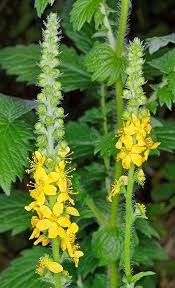
Agrimony is a native perennial, found widely across the UK and Europe in a range of habitats including hedgerows, roadside verges, woodland margins and open grassland, but not in deep shade, or damp locations. It blooms from June to August, and can grow up to 3′ / 1m tall, bearing spikes of small but bright yellow flowers, each with five petals. The reddish-brown fruit has hooked bristles or burrs: being caught in the fur of passing animals, this ensures distribution of the seed.
Seeds can be obtained from specialists so it can also be planted as a garden ornamental. As well as offering its bright colour, it is very slightly aromatic: some sources claim it has the scent of apricots. It also attracts beneficial insects – it is included in the RHS Plants for Pollinators – and is the food plant of some butterfly caterpillars.
Agrimony has many traditional and local common names, including Cockleburr and Sticklewort (referring to its bristly seeds) and Churchsteeples (referring to its tall pointed shape). Its botanical name is more complicated. The word Agrimonia is the Latin form of its common name, and is derived from Greek words which mean, depending on whose theory you prefer, ‘something that heals the eye’; or, ‘solitary field plant’; or, ‘a prickly poppy’.
The second half of its botanical name connects it to Eupatoria, a city on the Crimean Peninsula. This city was formerly known as Pontus, ruled over by King Mithridates VI Eupator from 132BC to 63 BC. He was known also as a physician and herbalist and was said to have invented an antidote to all poisons. As agrimony was believed to be a universal remedy, Linnaeus gave it the king’s name when he was classifying plants in the 17th century.
Medicinal Uses
Agrimony has a long history of medicinal use, dating back at least to the ancient Romans. In Britain, where it grows widely, it was known to the Anglo-Saxons as garclive, and used for healing wounds and snake bites.
Traditionally agrimony was considered an ‘all-heal’, beneficial in a large range of illnesses and conditions. It was given as a remedy for ailments of the digestive tract such as gallstones, diarrhoea and complaints of the bowel; and also for respiratory diseases from coughs and colds to bronchitis. As an anti-inflammatory and antiseptic it was used to reduce swelling and infection in cases of tonsillitis and bleeding gums. It is also reputed to have been made into a gargle for opera singers to protect their throats.
Agrimony was well-known to soldiers in medieval times, as it was used to heal battlefield wounds, including those caused by musket shot. Other external uses included the treatment of eye disease, ulcers, warts, dermatitis and other skin infections.
Modern science has found much to support these traditional remedies. Agrimony’s chemical properties, including a high level of tannins, stimulate the production of enzymes and stomach acid, which help in the assimilation of nutrients and are beneficial to the gut. Other compounds are said to be useful in treating intestinal worms. It is therefore used nowadays for a number of gastro-intestinal complaints, and is prescribed in some countries for diseases of the liver.
HEALTH WARNINGS
It is recommended not to take Agrimony at the same time as other medication by mouth, but to wait at least an hour, as the action of the tannins in the herb may reduce the effectiveness of the medication.
Diabetics taking medicine to lower their blood sugar are advised to consult their doctor before using Agrimony.
Myth and Magic
Agrimony has long been regarded as powerfully magical, and one of its earliest common names is “fairy’s wand”. In an 18th century Scottish witch trial, Agrimony was mentioned as a witch’s cure for people who were “elf-shot” or suffering unexplained illness.
As mentioned, the botanical name eupatoria refers to King Mithridates Eupator. There is a legend that he invented a medicinal antidote that would protect him from all earthly poisons.
Other uses
The flowers, (some say whole plants), were used from early medieval times to make a cream or yellow dye. It is still so used today, especially by craftspeople who prefer to make their own natural plant dyes in preference to commercial and synthetic colourings.
Acknowledgements – thanks to the following for much of this information
www.rhs.org
www.wildseed.co.uk
www.indigoherbs.co.uk
www.monaconatureencyclopedia.com
www.wildflowerfinder.org.uk