This page gives information about Hemp Agrimony, Eupatorium cannabinum, its medicinal and other properties and place in folklore.
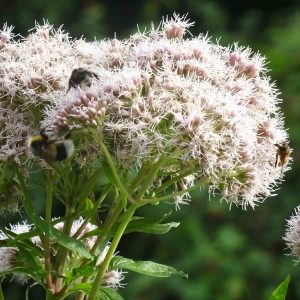
Hemp Agrimony is a tall, bushy perennial, usually found on river and canal banks, in marshes and fens, and in damp woodland and grassland. The flower clusters, pale pink and ‘frothy’ in appearance, open from July to September. In the UK, it is most commonly seen in the wild across Wales and Southern England, but we have planted it for its medicinal value in our physic garden in Cheshire.
Native to Europe, this widespread hardy plant is attractive to pollinating insects such as bees, beetles and butterflies, including the Small Tortoiseshell and Red Admiral. However, it is toxic to humans, and handling the plant, particularly the seeds, without gloves can cause irritation and skin burns; while ingesting it in any but the tiniest dose can cause violent vomiting and diarrhoea at best, and, at worst, death.
Despite its name, it is not related either to Hemp (i.e. cannabis) or Agrimony, two other quite distinct plants. It may have got the first name from the shape of its leaves, which resemble those of hemp. In earlier centuries it went by a number of different and equally confusing names, including Water Agrimony, Bastard Agrimony, Water Hemp, Gravel Root, even Hemlock Parsley.
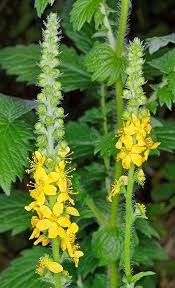
The two plants named Agrimony aren’t at all alike in appearance:
Medicinal Uses
Hemp Agrimony has been used for millennia in medicine. Avicenna, (980-1037), the Persian physician and philosopher, wrote about its medicinal uses, and Anglo-Saxons used it to treat wounds. It also has a long history of being utilised in cases of fever, digestive trouble, coughs and colds.
The leaves and roots of the plant are used, fresh and dried, in different preparations today, both in herbal and homeopathic medicine. The plant contains flavonoids, phenols, tannins, resin, and inulin. Its essential oil contains Cymene which seems to have antiviral properties; and it is thought that polysaccharides present in the herb may be used to stimulate the immune system in a positive way.
However, as stated above, Hemp Agrimony is POISONOUS and therefore we strongly advise against any attempt to self-medicate.
Myth and Magic
Pliny wrote that a powerful king, Mithridates Eupator, (120-63 BC), who was also an alchemist, was one of the first people to use this plant for its medicinal properties, which may have influenced the botanists who much later gave the plant its Latin name. Culpeper, on the other hand, said it was called “eupatorium and hepatorium because it strengthens the liver”.
The plant was known to some as Holy Rope, because they thought it was used to make the rope that bound Jesus Christ (again a connection to hemp, used for rope-making). Another name was Ague Weed, as it was believed to relieve fevers, and even prevent them.
In the Middle Ages, laying the plant on bread was supposed to prevent its becoming mouldy; and its juice was rubbed on cattle and horses to keep away biting insects. Culpeper refers to burning the herb to create smoke, that would not only drive away wasps, but also ‘strengthen the lungs’ – certainly not recommended today!
Acknowledgements Thanks to the following for much of this information
www.blog.metmuseum.org/cloistersgardens
www.thepoisongarden.co.uk
www.organicfacts.net
www.pfaf.org
www.gardenersworld.com
www.herbal-supplement-resource.com
www.wildlifetrusts.org