
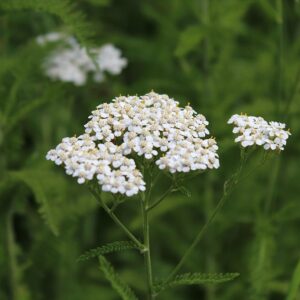
 Yarrow, Achillea millefolium, is a familiar native British plant that grows throughout the Northern Hemisphere. It is a hardy perennial, spreading through creeping rhizomes that can form a dense mat, and sending up a rosette of leaves in spring that soon develop into the familiar ‘stand’ of crowded aromatic leaves and flowering stalks.
The finely divided, fern-like leaves give it a delicate, wispy appearance; though in fact it is a hardy, mostly upright plant. Although it has a superficial resemblance to umbellifers such as Cow Parsley and Wild Carrot, they are not related. It is perhaps not immediately obvious that yarrow is a member of the Asteraceae plant family, as its small flowers do not have the familiar sun-ray appearance we associate with daisies, sunflowers and marigolds. It is one of only about three members of that huge family that has a mere five petals on each bloom. These grow in clusters to make up its familiar flat flower-heads, and vary from the most usual white, via pale pink and hints of lilac, to deeper shades of pink.
There are many garden cultivars in a far wider range of colours, but this page is principally about the native wildflower.
Yarrow, found across the temperate climate countries of the northern hemisphere, tolerates most habitats from meadow to waste ground, and from low-lying coastal fields to altitudes up to 1100 metres; it is found in rural and urban areas; and survives harsh winters as well as being drought tolerant. Unsurprisingly, it is known by a variety of regional common names, which in Britain include Devil’s Nettle, Thousand Leaf, Soldier’s Woundwort, Old Man’s Baccy, Staunch Grass, and Old Man’s Pepper.
Yarrow has been applied medicinally for millennia, often using its essential oil. This, unusually, is a deep blue colour, caused by the compound azulene. This chemical is also found in Scented Mayweed; and Wormwood contains a version of the same compound. These three plants are all found in different groups of the Asteraceae family, but the presence of azulene shows that these groups are even more closely related than others.
Medicinal
Yarrow’s long-held place in herbal medicine was substantiated when excavation of a Neanderthal burial site in Iraq yielded many medicinal herbs, yarrow among them. This medicinal history is based largely in its styptic properties (an astringent that stops bleeding). Its common names in many countries often reflect this property. One of its British common names is Nose-Bleed, which refers to an old practice of placing the leaves up into the nostrils to stem such bleeding.
John Gerard, the 17th century English botanist and herbalist, quoted the ancient writers Dioscorides, Pliny and Apuleius in his description of Yarrow and its medicinal qualities in his book Herball, or a Generall Historie of Plantes. Gerard’s was the standard textbook in his time, but much of his writing has been discredited; and many claims by other herbalists since his era have been disregarded in our modern enthusiasm for synthetic pharmaceuticals.
However, Yarrow’s wound-healing property was confirmed for sceptics by modern scientific research: this identified a compound that assists the coagulation of blood, to which the researchers gave the appropriate name achilleine.
The successful healing of cuts, sores and burns is helped by other, anti-microbial and anti-inflammatory, properties found in yarrow. But scientists have identified over forty different constituents in yarrow, supporting a reputation for other medicinal applications.
Surprisingly, given its blood-clotting reputation, yarrow also has properties that actually improve blood flow, which has led to its use in treating such complaints as varicose veins and rheumatic conditions. Similarly, it has long been prescribed for menstrual and menopausal aspects of women’s health, and there are claims that it can help with female fertility.
Yarrow preparations have been used for gastro-intestinal conditions, from heartburn and indigestion to helping to prevent gall stones. It is also prescribed to reduce fever and induce sweating, and its general astringency is useful in a number of applications, both external and internal.
Yarrow also has analgesic properties, thus giving pain relief in addition to its other healing aspects. It contains salicylic acid, a compound also found in Meadowsweet and Willow, now usually made synthetically and familiar to us as aspirin.
Yarrow herbal products available today include creams and lotions, and it can be taken internally as a herbal tea. In a carrier oil it can be used to soothe aching muscles and sensitive skin; and in aromatherapy it is used to disperse pathogens from the patient and ease the discomfort produced by coughs, colds and bronchitis.
NOTES
The British Herbal Medicine Association states “Registered herbal medicines containing yarrow are used for the symptomatic relief of rheumatic pain and general aches and pains in the muscles and joints, based on traditional use only”.
People with particularly sensitive skin may find yarrow causes an allergic reaction – as always, we recommend caution when using herbal remedies.
Myth and Magic
Yarrow’s botanical name Achillea derives, as mentioned, from the ancient Greek myths about Achilles. The warrior hero’s battlefield exploits included healing his men’s wounds with yarrow. The other part of the name, millefolium, meaning ‘thousand leaves’, aptly describes its appearance.
In China dried stalks of the herb have been used for millennia for the rites of divination in the reading of the I Ching. It is also said to grow beside the grave of Confucius.
In Scotland, where it is also known as Yarra, Doggie’s Brose and Melancholy, young women traditionally placed yarrow leaves under their pillows to call up dreams of future sweethearts and find out whether they would marry.
A collection of Gaelic folklore, including many charms, rhymes, blessings and songs from the Scottish isles, was made in the late 19th and early 20th century by Alexander Carmichael, who also translated them into English and had them published in a series of books. They were republished in 2006, and include this charm:
I will pluck the yarrow fair
That more brave shall be my hand
That more warm shall be my lips
That more swift shall be my foot
May I an island be at sea
May I a rock be on land
That I can afflict any man
No man can afflict me
Other Uses
In Sweden, yarrow is one of the herbs used for flavouring beer; and it was similarly used as a preservative and flavouring in brewing in medieval Scotland before the introduction of hops. The young leaves, though sometimes bitter, can be used in salads.
Acknowledgements Thanks to the following for much of this information
https://www.rxlist.com
https://www.permaculture.co.uk
https://www.indigo-herbs.co.uk