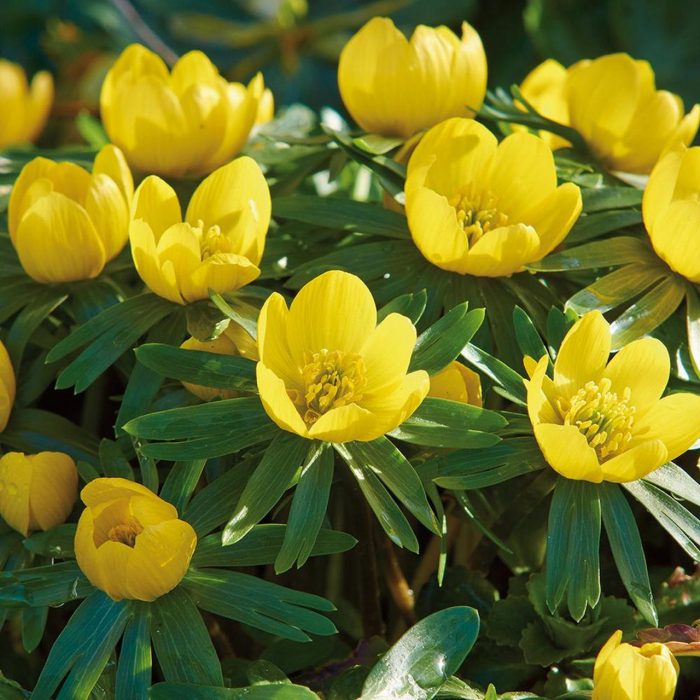
 The Winter Aconite, though common in the UK since at least the sixteenth century, is not an indigenous plant, being a native of southern Europe. Popular in the spring garden, it has naturalised widely beyond the garden gate into ‘wild’ areas.
Medicinal Properties
There seems to be very little recorded about Winter Aconite as a medicinal plant, despite Gerard’s belief that it could cure the scorpion’s bite… There is a brief mention, in a history book about Cattle Plague, that it was used in the 18thcentury to cure blisters on cattle. Currently, it seems to appear only on homeopathic medicine websites.
So it is perhaps more helpful to regard this charming early spring flower as simply a delightful addition to the glory of the garden!
Myth and Magic
The most prevalent myth is that Winter Aconite is the source of a deadly poison. It isn’t. Many internet sites refer to its legendary and fictional, as well as historical, uses in murder, but they are confusing it with the aconitine poison derived from the purple Aconitum napellus, Monkshood. Agatha Christie used aconitine in two of her stories, but she wouldn’t have tried it with Winter Aconite!
It’s something of a mystery that this plant has the same common name as a completely different and very poisonous one. One theory points to the herbalist John Gerard, (1545–1612), who described it as Aconitum hyemale,blending two names and ascribing the deadly poison of the larger purple plant to the relatively innocent little yellow flower. It is also thought that under the medieval ‘Doctrine of Signatures’ (plants having medicinal properties according to their appearance), their leaves were considered sufficiently similar that the plants would necessarily have the same properties.
But they haven’t. Like any member of the buttercup family, Winter Aconite is inedible and indeed poisonous – although medical sources disagree about just how toxic it is. Eating a lot of it would undoubtedly result in sickness at the very least – but who would want to?
Acknowledgments– thanks to the following for much information
– http://www.thepoisongarden.co.uk
– http://www.professorhedgehogsjournal.wordpress.com
– http://www.garden.rcplondon.ac.uk
– http://www.gardenseeker.com