
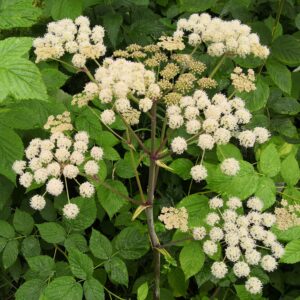
 Read here about Wild Angelica, Angelica sylvestris, its medicinal properties and place in folklore.
Wild Angelica, native to Britain, Europe and parts of Asia, is a sturdy biennial or short-lived perennial. The term sylvestris literally meaning ‘of the woods’, it nevertheless tolerates many types of soil, found not only in woodlands and hedgerows, but often in damp areas and marshes or by streams and on canal banks. A member of the huge umbelliferous plant family Apiaceae, that includes carrots, celery and wild parsley, it has beautiful flat heads of tiny white or lilac-pink flowers that attract many pollinating insects including bees, beetles and hoverflies. The flat, oval seeds have thin papery wings, helping their air-borne dispersal. We assume our specimen arrived by this means: it was seen in the Physic Garden for the first time in 2020.
Common names include ‘Poor man’s Angelica’ and ‘Woodland Angelica’. The stems are rigid, purple and green, with highly-divided leaves. The colours of the flower and stem are good markers to distinguish the wild species from the more frequently seen Angelica archangelica, a much taller relative that is a popular garden plant. To add to the potential confusion, the garden variety has become naturalised in some parts of the UK; and cultivars of the more colourful wild flower have been developed for planting in gardens – the RHS recommends A. sylvestris ‘Vicar’s Mead’, for instance.
[For information on Angelica archangelica click here].
Medicinal Uses
There is far less written about the medicinal uses of Wild Angelica than those of its garden relative, as the latter has been cultivated for centuries and has all the properties found in the wild flower but to more potent effect.
There are, however, some specific references in Irish folk medicine to wild angelica, where they recommend chewing the roots of the plant before breakfast – which would apparently cure heart palpitations and promote urination. They also considered wild angelica to be a treatment for epilepsy and for hydrophobia (this fear of water is a symptom of rabies).
Nicolas Culpeper wrote, in his 17thcentury Herbal, an item full of praise for the many medical and other properties of Garden Angelica. He mentioned Angelica sylvestris in this single sentence: “the wild angelica, that grows in the low woods and by the water, is not of such virtue; yet the surgeons steep the root of it in wine to heal infected wounds”.
A century earlier, the herbalist John Gerarde had written that a piece of the root held in the mouth, or chewed, would drive away “pestilential air”– by which he meant the noxious atmosphere that, according to belief at the time, caused the Plague.
John Parkinson says of Angelica that “it is so goode an herbe that there is no part thereof but is of much use.” He was, like Nicolas Culpeper, a 17th century herbalist; but he was also a serious botanist, developing a botanical garden in Covent Garden and maintaining relationships with other prominent British and European botanists and plantsmen. Also, unlike the rebellious Culpeper, Parkinson was a member of the Establishment: apothecary to James I, a founding member of the Worshipful Society of Apothecaries, and Royal Botanist to Charles I. The comment about Angelica comes from one of his books, Paradisi in Sole Paradisus Terrestris, published in 1629.
Other traditional medicinal uses of the plant include promotion of menstruation (even to produce an abortion); stimulation of the production of phlegm; treatment of bronchial and rheumatic ailments; increase male sex drive.
WARNING: All species of Angelica contain phototoxic compounds which may cause a skin irritation in the sun.
Culinary Uses
All parts of the plant are edible. While garden angelica is the usually the variety of choice, wild angelica may be substituted in most recipes, while noting that the stems and leaf stalks are tougher and more bitter compared with the garden variety.
Young leaves and stems can be boiled as a vegetable; and the chopped leaves can be used as a sweetener , for example when stewed with rhubarb. Candied stalks and stems are used as decoration or in sweet recipes.
The root also has a sweet taste; and the seeds can be used as a spice.
Myth and Magic
Many sources for folk-lore and traditional medicine simply use the name Angelica, and it is often very clear that they refer to A. archangelica. This is unsurprising, as this plant has been cultivated for many centuries and is a common sight in cottage and physic gardens alike.
Angelica sylvestris apparently has an old common name, Holy Ghost, or Root of the Holy Ghost, implying that it is a gift from God. In the 17th century, John Parkinson described Angelica by this name, and said it had ‘angel-like’ properties. It is however quite likely this epithet was given to all angelica plants including the garden variety, since their contribution to herbal medicine was so similar.
Acknowledgments– thanks to the following for much of the information above
www.eatweeds.co.uk
www.pfaf.org
www.rhs.org.uk
www.rxlist.com
www.wildseed.co.uk
www.wildlifetrusts.org
www.gardenersworld.com
www.Gutenberg.org for ebook #44638 Plant Lore, Legends and Lyrics, by Richard Folkard, originally published in 1884