
White Mulberry, (Morus alba), has been used in Chinese and other traditional medicines for millennia, and can now be found in modern supplements, for its potential health benefits. It is considered to be efficacious in treating Diabetes Mellitus, and also to support healthy weight and cholesterol. Leaves, bark, roots, and fruit of the tree have all been used medicinally.
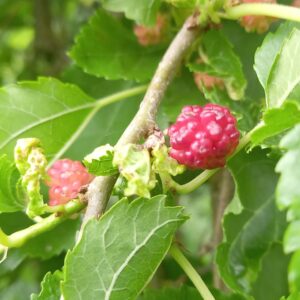
Recent scientific investigations have confirmed that chemicals in White Mulberry are useful in lowering glucose levels, but further research on a wide range of other compounds is needed.
As well as its medicinal applications, Mulberry plays an essential role in the production of silk, and is planted in the Industry border at the Physic Garden in recognition of the textile history of Congleton. The accompanying picture show its early fruit in July 2023.
Mulberry is the food of choice for the silk moth caterpillar (silkworm), and Black Mulberry (Morus nigra) grows well in Britain. Centuries ago, unlike today, the tree was found in many gardens and orchards, and the fruit was commonly eaten fresh, cooked in desserts and pies, or preserved in jams and jellies. But such trees are not as good for silk moths as White Mulberry.
Silk had long been imported from China, but in the Middle Ages production started in Europe. By the 15th century France was the industry leader, as White Mulberry trees thrived in the warm climate. As a luxury item, importing silk was expensive and James I decided that England needed its own source of this valuable commodity. In about 1610, he ordered 10,000 young mulberry saplings to kickstart an English silk industry. However, by accident or ignorance, he ordered Black Mulberry, and either the trees, or the silkworms, failed to produce the goods. England – and later Britain – remained reliant on imported silk.
So we have no home grown silk, but in the past Congleton mills did weave silk fabric from imported thread. Our local Museum, and those in Macclesfield, will tell you more about the silk industry – and go to www.moruslondinium.org if you want to know more interesting facts about Mulberries!
(This is an adapted extract from a blog, by this author, on the original website for Congleton Bath House & Physic Garden)