
 Read here about Wall Germander, Teucrium chamaedrys, its medicinal properties, other uses and place in folklore.
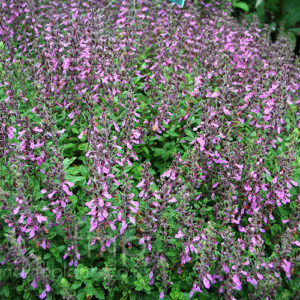
It is a member of the large plant family Lamiaceae, which includes many aromatic herbs such as mint, basil, sage, marjoram and thyme, as well as larger shrubs such as lavender and rosemary. The flowers of all these otherwise varied plants are similar, having an open ‘mouth’ with lobed lip-like petals. Wall Germander is a clump-forming ‘sub-shrub’, with spreading roots, that usually grows not much taller than 12 inches / 30 cm. It has glossy, deep-veined and tooth-edged leaves that, being evergreen, make a useful contribution to the winter garden. In summer, it produces spikes of attractive purplish-pink flowers, that in our garden droop gracefully down the wall against which it has been planted. It can be trimmed after flowering if it gets too untidy.
Although not recommended as a culinary herb like so many others in its family, germander’s pleasant smell appeals to florists and craft workers, who use its dried stems and leaves in pot-pourri and aromatic wreaths.
Germanders were once common in British gardens, but have fallen out of fashion, which is a pity as they are very successful in attracting pollinators, including butterflies and bees.
Wall Germander is recommended by some plant suppliers for low hedging, such as you’d find in knot gardens, but we use its close relative – Hedge Germander (Teucrium x lucidrys) – for this purpose.
Medicinal Uses
The entire Lamiaceae family is rich in volatile oils, some very pungent and aromatic, with the most penetrating of these oils being menthol. These oils have a stimulant and warming effect on the body, and so have been used in medicine for millennia to encourage sweating or to assist respiration, as when Dioscorides, the ancient Greek physician, recommended Germander for treating coughs and asthma.
Wall Germander(Teucrium chamaedrys) has a long history of use in a variety of other treatments, principally to induce urination and sweating, or as an antiseptic, or in preparations to treat irregular menstruation. The whole plant would be infused, and drunk as a herbal tea or used as a gargle or mouthwash. The leaves were compressed into a poultice, and applied to whichever area of the body needed their antiseptic properties. It was considered a harmless herbal supplement well into the 20th century, as a tisane or in other preparations.
BUT… Teucrium chamaedrys was the main ingredient in a French medicine, prescribed for weight-loss in the 1990s, that was linked to a number of cases of chronic and acute hepatitis, and at least one death. Several scientific studies followed, and it was proved through this research that ingesting germander can cause severe liver damage. Several European countries subsequently banned germander products.
WARNING Our advice is, as always, to avoid self-medication; and you should be especially cautious about any preparation that mentions ‘Germander’ as an ingredient.
Myth and Magic
The main ‘story’ about Germander is that the name isn’t applied to just one plant, and in the modern era when a quick ‘Google’ brings up a huge array of information, distinguishing the well-researched from the merely copied-and-pasted does take time and effort. Casually attributing particular qualities to different plants can reinforce misleading myths and certainly won’t produce magic!
It is very evident that the common name Germander refers to quite a range of plants, variously native to Europe, to Asia, to North or Central America. We at the Physic Garden think of Germanders as being either Hedge or Wall; but, internationally, seed and plant growers, herbalists, botanists and gardeners may happily use the word Germander for many others. There are even unrelated flowers, such as Germander Speedwell and Germander Sage… Confusion is not always dispelled by the Latin names, either!
Acknowledgements – thanks to the following for much information
www.britannica.com
www.wildflowers-and-weeds.com
www.usethatherb.com
www.PFAF.org
www.hooksgreenherbs.com
www.thespruce.com
www.sciencedirect.com (for academic research articles)
RHS Encyclopaedia of Herbs