
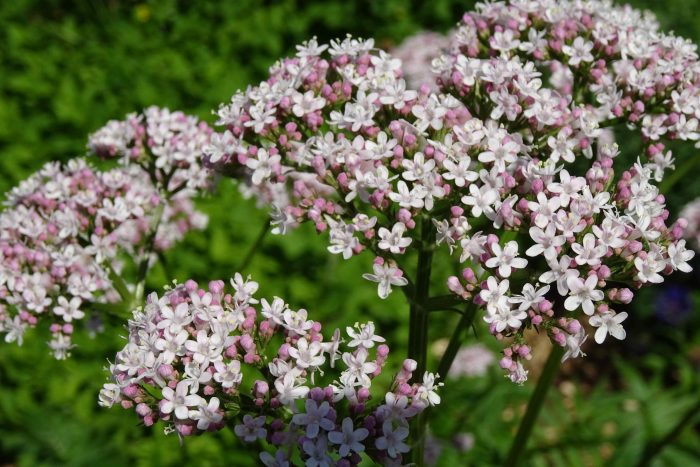
 Valerian (Valerian officinalis) is a native plant, often growing near water, tall, with many branching stems topped with white or pale pink flowers, and attractive to butterflies and bees. It has a recognisable scent, which some people find pleasantly musky, while others refer to its similarity to dirty socks… Ancient writers apparently called the plant phu – like ‘pooh’ – so were obviously in the latter camp!
Not to be confused with Red or Garden Valerian, (no relation), introduced as an ornamental, and now a widespread garden escapee, which prefers dry, well drained conditions, tolerates lime, and is seen locally growing out of walls and taking over patches of wasteland – this is Centranthus ruber, native to warmer Mediterranean climes, with no medicinal value, though its vivid blooms are attractive both to gardeners and to bees, and in some countries the leaves are added to salads. Wind-borne seeds quickly set up home – free plants!
Medicinal Uses
It is the root of Valerian that is usually indicated when describing medicinal properties, although the leaves can be dried and made into a tea or tisane. It has been used as a medicinal herb for at least two millennia, with many ancient texts describing its properties: Galen used it to treat insomnia, Pliny believed it brought pain relief and Dioscorides wrote that it was both a diuretic and an antidote to poison.
In medieval times, valerian was used for so many therapies that it was also known by the name of ‘All-heal’ . In the 16th century, Gerard’s Herball said it was excellent ‘… for such as be troubled with croup … and also for those that are bruised with falls’. In the following century, Nicholas Culpeper recommended its use for coughs, headaches, ‘dimness of the eyes’, flatulence – and even against the plague.
Valerian was used in the treatment of ‘shell shock’ in World War One, and was listed in both UK and US official pharmacopoeia up to the middle of the 20thcentury. Valerian remedies are widely available over the counter today in many European countries.
Modern medicinal herbalists still prescribe valerian extract – in tea, tincture, capsule or tablet form – as Culpeper did, for colds, fevers and shortness of breath. Its greatest medicinal value, however, is as a sedative. It is frequently prescribed for insomnia. Modern scientific research supports this, having identified those of its properties that affect the central nervous system, and recent studies show that it is as effective as some synthetic drugs without the unpleasant side-effects.
WARNING: as with any tranquillising drug, users should not take alcohol, nor drive any machinery, when using valerian; and pregnant women should avoid it. Also, prolonged use of larger doses can result in headaches, nausea, and other symptoms of poisoning.
Myth and Magic
Valerian’s name may derive from the Latin verb valere, meaning to be healthy.
The herb was used by magicians and sorcerers in love potions; and in herbal pillows to induce sleep. It was also claimed to tame wild animals and attract rats. There is a theory that the Pied Piper of Hamelin may have been using valerian root as well as music!
Valerian was hung in their homes by the ancient Greeks to keep evil spirits away, and by the Celts to prevent lightning strikes.
Acknowledgments– thanks to the following for some of the information above:
www.victoriananursery.co.uk
www.theguardian.com
www.rhs.org.uk
www.theherbalacademy.com
www.theherbgardener.blogspot.co.uk
Culpeper’s Complete Herbal