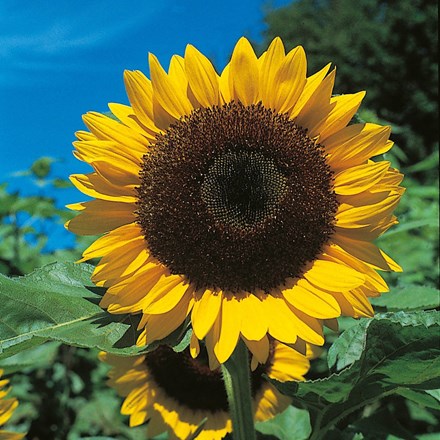
This page is about the Sunflower, Helianthus annuus, its medicinal and other properties and place in folklore.
Sunflowers are native to Central and South America, introduced as an ornamental plant into the UK in the sixteenth century. The English name Sunflower was however already in use before this time, so must originally have referred to a different species, perhaps the Pot Marigold, Calendula officinalis, which resembles an image of the sun with many rays; or the Rock Rose, Helianthemum vulgare, that only opens in sunshine and is mentioned in early herbals. There are also dozens of ornamental sunflowers, including this one, developed from the wild plant and offering the gardener a wide range of colour, size of flower and height of stem.
Medicinal Uses
The leaves, flowers, seeds, and even the root have all been used in herbal medicine
Leaves: Tea – astringent, diuretic and expectorant – used for fevers Crushed – as a poultice on sores, snake bites and insect bites
Flowers: Tea – to treat malaria and lung complaints, fever and stomach upset
Roots: Crushed into a warm wash for rheumatic aches and pains
Seeds: Infused for relief of bronchial, pulmonary and laryngeal conditions and whooping cough; mixed with wine as a substitute for quinine in treating fevers
Modern scientific research finds that sunflower seeds contain protein, amino acids, vitamins, and minerals, and make an excellent ‘energy snack’.
WARNING: the pollen and extracts from the plant can cause an allergic reaction in some people.
Culinary and other Uses
Although we tend to associate vast fields of sunflowers with the Mediterranean, they have also been grown commercially in the UK since before the 1st World War. They made an excellent commercial crop in the early years of the 20th century, as they had so many uses:
the leaves for cattle feed;
the fibrous stems for paper-making;
the seeds to feed pheasants and chickens;
the oil from the seeds for cooking and industrial processes;
the residue after oil processing for cattle-cake; and
the flowers to make a yellow dye.
The 17thcentury herbalist, gardener and writer John Gerard referred to the plant’s culinary and aphrodisiac properties, calling it the Marigold of Peru: “the buds before they be floured, boiled and eaten with butter, vineger, and pepper, after the manner of Artichokes, are exceeding pleasant meat, surpassing the Artichoke far in procuring bodily lust.”
Nowadays sunflower oil is considered one of the healthier oils for cooking purposes, and the seeds are widely used, raw or cooked, in many cuisines.
Myth and Magic
It is a widespread belief that sunflowers turn to face the sun, but this is not the case. John Gerard, four centuries ago, had already pointed this out: “ [some people] have reported it to turn with the Sun, the which I could never observe, although I have endeavoured to find out the truth of it”. In fact, although immature flower buds do twist around as they grow, (as a result of the unequal growth of the flower stalk), the mature flowering heads point in a fixed direction throughout the day, most commonly to the east. Despite the evidence, in Europe the plant’s common name often refers to this belief (Italian girasole, French tournesol, Greek iliotropio).
Native peoples revered the flower in many parts of South and Central America, its original habitat, and it played an important part in the worship and ritual around their deity, the sun god. European conquistadores found many solid gold images of sunflowers, (and no doubt these too were brought back to Spain along with the plant itself).
In 2008 researchers found evidence that the plant was being cultivated in Mexico as long ago as 2,600 BC. They also learned the names that were given to the sunflower in the languages of the indigenous peoples still living in the region today. One name translated as ‘the big flower that looks at the sun-god’ and another as ‘the shield-flower’, references to sun worship and war (Aztec shields were round) that have long survived the conquest.
Acknowledgements – thanks for information to:
www.naturalmedicinalherbs.com
www.pfaf.org
www.motherearthliving.com
www.thousandeggs.com
www.pnas.org (research paper on sunflowers in Mexico)
www.botanical.com (quoting from A Modern Herbal*, first published in 1931)
* This book is frequently referenced by bloggers and others, though some of the ‘facts’ regarding medicinal properties are not always substantiated, and since publication some have been disproved by modern scientific research. A delightful and useful resource, but one to use with caution.