
 Here you will find information about the Silver Birch, Betula pendula, its medicinal and other properties, and its place in folklore.
One of two birches native to the British Isles, (the other being the downy birch Betula pubescens, with which it often hybridises), silver birch is a “pioneer” species, quickly colonising ground cleared by agriculture, forestry or fire. Its seeds are light and can be blown great distances, and easily germinate in poor soils. Birch leaves are quick to rot and enrich the soil, enabling other species to become established such as beech and oak; however, if they are not managed carefully, forests so made eventually become too dark for the birch trees to survive.
Popular in gardens as well as growing widely in the wild, this tree is easily identified by the silver-white peeling bark on the trunk that gives the plant its common name. The twigs are slender and sometimes drooping, (as referenced in the second part of its botanical name).
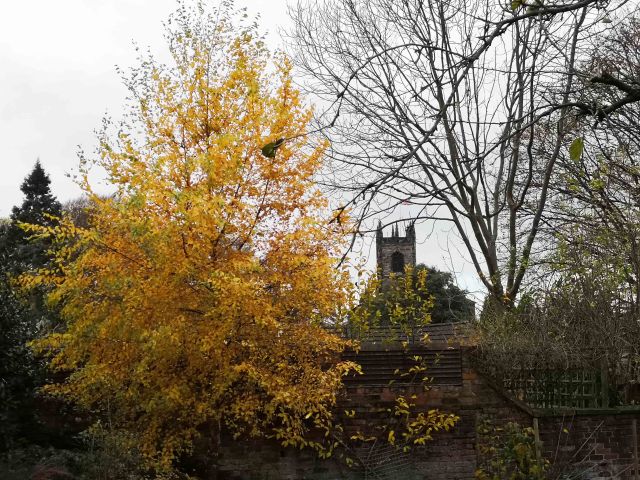
Our image shows the birch in the Physic Garden in its full autumn colour.
Medicinal Uses
Birch has been important in herbal medicine for millennia, having a wide range of applications. An infusion of the leaves taken as a non-irritant diuretic was long prescribed for dropsy, a condition characterised by excessive water retention. It was also used in cases of urinary tract infection. A decoction of the bark was used as a disinfectant for wounds, and for reducing inflammation in arthritis and gout.
Modern science recognises that birch contains useful chemicals and compounds, including potassium, which regulates fluid balance, muscle contractions and nerve signals. Birch also contains a high level of vitamin C, which is considered helpful in cases of viral infections. It also contains salicylates which, like salicin (the compound derived from willow), can help in pain relief and in reducing the symptoms of fever. There has also been recent scientific interest in betulinic acid, derived from betulinol, a compound found in birch bark, which may prove beneficial in the treatment of cancers, although research is at an early stage.
A fungus that grows exclusively on Birch trees also has medicinal properties. Birch Polypore (Piptoporus betulinus) is a parasite that kills the tree slowly, and continues to live on the dead tree for years. It emerges from the trunk in a ‘hoof’ form, then gradually becomes flattened. It has been used medicinally for millennia: for example, it is believed that it may have been taken by Bronze Age people get rid of parasitic worms. Made into a ‘tea’, it is taken as a tonic for the immune system; and a strip of the membrane can be made into a self-adhesive, microporous, anti-fungal dressing. Dried pieces of the underside of the ‘hoof’ were used by barbers for stropping their razors, giving it the common name Razor Strop Fungus. The barbers were probably unaware that in doing so they were actually cleansing the blade, as it has antiseptic properties and has long been used to help in the healing of wounds. Birch polypore is now being researched for its potential in anti-biotic, anti-viral and anti-tumour applications.
Other Uses
Sap: Silver birch wine is made from the sap, and a vinegar can be derived from this.
Bark: The waterproof bark has been used by such peoples as the Sami of northern Europe, and Native North Americans, as a light-weight roofing material and, perhaps most famously, for their canoes.
Bark: An oil or tar, known for thousands of years, is made from the dry bark by a similar method to that used to make charcoal. It is a many-purpose adhesive and can also be used to treat leather and wood or add scent to soap and perfume.
Twigs and Buds: Even without medicinal properties, birch is said to make a pleasant drink, as this recipe found on line suggests:
Gather a few handfuls of fresh silver birch twigs with buds
Steep in boiling water to the required taste
Strain the liquid, drink and enjoy!
NB: We haven’t tried this ourselves…
WARNING:
The presence of salicylates in birch products means they should not be taken by anyone sensitive to aspirin.
Myth and Magic
The silver birch was considered holy by pagan peoples, a tree that drove out evil: for example, cradles made from birch wood were thought to protect the new baby from demons. A tree common in northern Europe, it appears in many ancient tales in these cold countries where its medicinal and practical properties were well-known. Birch was sacred to the Norse goddess Frigg / Freya, and it was birch twigs that made a bed for the legendary Irish lovers, Diarmuid and Grainne, when they fled from the latter’s betrothed, Fionn mac Cumhaill. In Irish mythology, the tree was also associated with the god Lugh, whose name means light. Welsh legends mention it in connection with Blodeuwedd, the wife of Lleu Llaw Gyffes, whose first name is the Welsh equivalent of Lugh.
Silver birch was revered by Druids in Britain; and birch branches were used to start the fires of Beltane, the Celtic festival associated with fertility and new life, celebrated at the beginning of May. Beltane rituals included dancing round the May Pole, which was also made from birch wood.
‘Beith’ or birch is the first symbol (B) of the Ogham alphabet, used on stone monuments and manuscripts between the 4th and 9th centuries AD. Stone examples have been found throughout Ireland, and also in England, Scotland, the Isle of Man and Wales. The word is still found in many Gaelic place names such as Glen an Beithe, Allt Beithe, and Beith in Ayrshire. Another old spelling of the tree was ‘birk’ and this appears in place names in Scotland and England. Although we can’t be sure of the derivation, we might like to think of Birkenhead and Birkdale as two relatively local examples.
An association with witches derives from the dense clusters of short twigs that sometimes grow on birch trees, caused by a fungus (Taphrina betuliina). These growths, which don’t harm the tree, are commonly known as witches’ brooms.
ACKNOWLEDGMENTS – Thanks for much information to the following:
www.folklorethursday.com
www.schoolofthewild.com
www.primitiveways.com
www.motherearthnews.com
www.thepresenttree.com
www.pharmaceutical-journal.com
www.heathline.com
www.wildfooduk.com (for Birch Polypore)