
This page is about Marsh Marigold, Caltha palustris, that is sometimes called Cowslip in the USA. It should not be confused with the plant known in the UK as Cowslip, Primula veris.
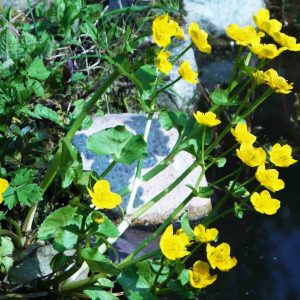 Marsh Marigold is a perennial flowering plant native to the UK and most temperate regions across the northern hemisphere. It is considered one of the UK’s most ancient plants, probably growing here since before the last Ice Age. Despite loss of wet grassland habitat through drainage and agricultural development, it remains relatively common in Britain. The botanical name Caltha is derived from the Greek for goblet, a nod to the flower’s cup-like shape, while palustris refers to its preferred marshy habitat.
A plant of ponds, ditches, shallow streams and other water edges and boggy areas, it absorbs water in its thick, dark green, waxy leaves during dry spells. The leaves have a high gloss, and a similar gloss on its bright golden blooms might have given rise to the alternative common name Kingcup. Preferring full sun, it forms large clumps and generally blooms from late April or May, and may even produce a second flowering later in summer.
It has also become a favourite for garden ponds, providing shelter for frogs and a source of nectar for insects: we are pleased that it flourishes in the boggy environment around our Physic Garden wildlife pond, as seen in the image.
Medicinal uses
Like other members of the Ranunculaceae (buttercup) family, the fresh plant is known to act as an irritant on contact with the skin – and this suggests that ingesting it, certainly without further preparation, may irritate the soft tissues and membranes of the throat and other digestive organs. Several medical websites claim that all Caltha species are toxic, and advise avoiding all use of this plant internally.
Traditional medicine, however, used Marsh Marigold in remedies for anaemia and insomnia, to alleviate rheumatic pain, to cure epilepsy and even to remove warts. In North America the native peoples used the root in particular, but other traditional preparations were also made from the leaves.
Many commentators, even while mentioning these historic claims, point out that there is little or no modern scientific research supporting any of them. A homeopathic website quotes from the 1902 textbook Materia Medica by John Henry Clarke on the use of Caltha palustris. He stated it was “an unproved remedy” for Pemphigus, a condition that causes blistering of the skin, particularly around the mouth. The website also states that Caltha palustris is not available over the counter and is not approved by the FDA.
As well as the traditional remedies mentioned above, the plant was also prescribed as an emetic, and a herbal ‘tea’ made from the leaves could be used as a laxative. We have observed before that these attributes are suggested for many plants in traditional medicine, and it is surely not surprising that ingesting even a mildly toxic plant might very well result in diarrhoea and vomiting…
We should also remember that many of these remedies pre-date any real knowledge about the cause, or even sometimes the actual bodily site, of some diseases and conditions. Causing a patient to rid themselves physically of the problem in this way might well have worked in some instances: literally, kill or cure.
CAUTION: handling the plant with bare hands may result in a rash or other skin irritation, and it is toxic if eaten.
Myth and Magic
Marsh Marigold comes into flower around Beltane, the ancient Celtic festival marking the return of summer. Beltane occurs midway between the spring equinox and the summer solstice, and roughly translates as ‘bright fire’. Large bonfires were lit, and houses were decked with yellow spring flowers, representing the light and fire of the sun: the vivid shining petals of Marsh Marigold would be prominent among them.
In the Isle of Man the appearance in spring of the Marsh Marigold bloom, locally known as Mayflower, was considered a good omen and the flowers were strewn on doorsteps.
Acknowledgments – thanks to the following for much information