
Read here about Hazel, Corylus avellana, its medicinal properties, other uses and place in folklore.
Hazel is native to the UK, widely found wild in mixed woodland and hedgerows, and in managed woods. The flowers of the hazel appear on bare branches, though clustered catkins of male flowers may be seen among the autumn leaves before they produce pollen in early spring before the new leaves arrive. The tiny female flowers look like vivid red ‘pompons’. Nuts develop in clusters of four, and the tree’s common name comes from Anglo-Saxon ‘haesel’ meaning cap or helmet, as the nuts appear to be wearing a leafy hat (or warlike helm!).
The timber has many uses and a commercially useful crop of timber is produced by coppicing, an ancient method of woodland management still practised widely. Young trees are cut down to stumps from which new shoots grow: after a few years these also are ready to be cut, and so the process continues. By harvesting trees at different times, there is a constant supply; and another benefit is that the coppice, or copse, provides a varied natural habitat for other species. Hazel pollen can be collected by bees; the trunks are often colonised by mosses and lichens; the nuts are eaten by woodpeckers, nuthatches, tits, wood pigeons, jays and small mammals.
Medicinal Uses
The herbalist Culpeper wrote: The milk drawn from the kernels with mead or honeyed water is very good to help an old cough…He also suggested drinking a mix of dried hazel husks in red wine as a remedy for diarrhoea.
Hazelnuts (also known as cobnuts or filberts) are a source of vitamin E, unsaturated fatty acids, and linoleic acid, useful in dietary supplements. Obviously, these should nonetheless be avoided by people with nut allergies.
North American native peoples used the American variety of hazel, Corylus americana, in treating fevers, skin ailments and wounds.
Culinary Uses
Hazel nuts are a principal ingredient in a popular nut chocolate spread, and in other confectionery. Raw or cooked, whole or chopped, pressed into oil or ground into flour, they feature in a variety of sweet and savoury recipes.
European centres of production are found in France, Italy, Spain and Turkey. In the USA the fruit is more often known as cobnut – the US-grown variant of the tree is the Corylus americana – and commercial production is centred on Oregon.
Other Uses
The timber of hazel has been used historically and in the present day to make a wide range of useful goods: furniture; fences, hurdles and stakes; baskets; shepherd’s crooks; poles and plant supports; and water-divining rods.
Hazelnut oil is used in the cosmetic industry.
Myth and magic
The Hazel tree was revered as a symbol of fertility and in Ireland as the ‘Tree of Knowledge’. It was considered to have magical powers for protection against evil spirits. A hazel rod is supposed to protect against evil spirits, as well as being used as a wand and for water-divining. In some areas of England, hazelnuts were once worn as charms against rheumatism.
The nut is also called a ‘filbert’ in Britain and parts of Europe. It is claimed that this is because St Philbert, a French saint, is celebrated on 24th August when hazel nuts are ready for harvesting. Other scholars say it is a corruption of the German word volbart, meaning ‘full beard’, a reference to the appearance of the nut in its outer covering.
Acknowledgements We are grateful for information sourced from:
www.drugs.com
www.woodlandtrust.org.uk
www.rhs.org.uk
www.thespruceeats.com
www.medicinalherbinfo.org
Culpeper’s Complete Herbal: A Book of Natural Remedies for Ancient Ills
The Physic Garden’s Corkscrew Hazel Tree
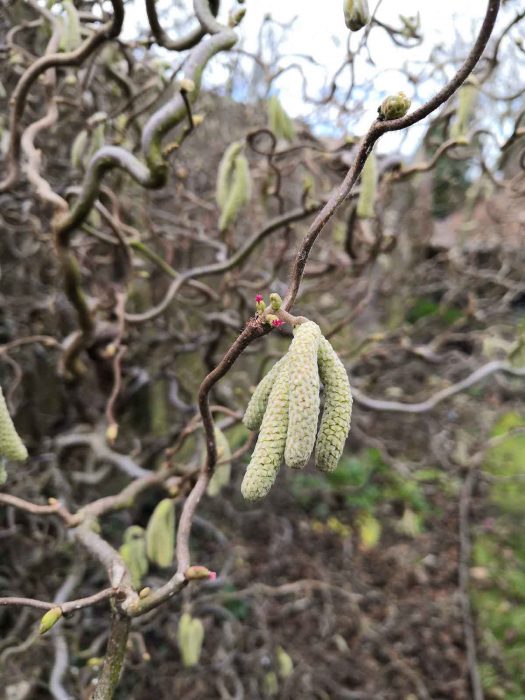
In the Physic Garden, we have a Corkscrew Hazel, Corylus avellana ‘Contorta’, growing against the west facing brick wall. This garden variety arose as a ‘sport’ of the native tree, found in a Gloucestershire hedge in the 19thcentury. Cuttings were propagated as a curiosity and then became popular. All true corkscrew hazels are descendants of this plant.