
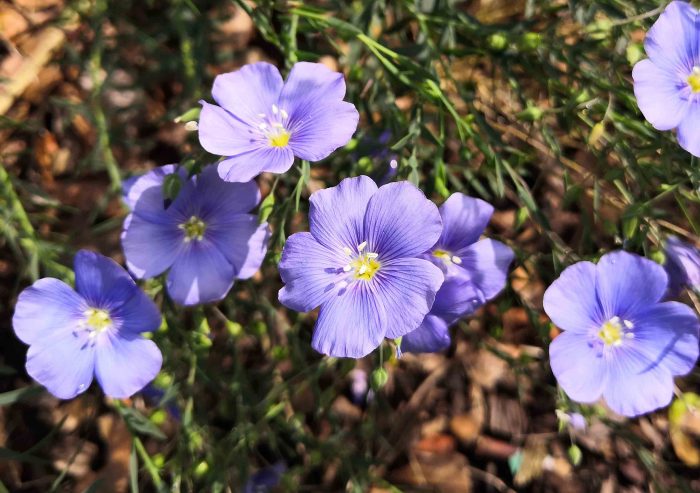
 Read here about Flax, Linum perenne, its medicinal and other properties.
This native plant, sometimes referred to as Linum perenne subspecies anglicum ( to distinguish it from other similar plants more commonly found in Europe) has the alternative common name Blue Flax.
Medicinal Uses
Oil from the seeds of Linum perenne has soothing and lubricating properties, and can be used to treat tonsillitis, coughs and constipation.
WARNING: Its seeds should not be eaten raw.
Other Uses
A fibre used in the production of linen thread can be obtained from the stems, but this is inferior to that from Linum usitatissimum, or Common Flax, one strain of which is commercially grown for that purpose.
A second strain of Common Flax is cultivated for its seeds: these, like those of L. perenne, are used for culinary, medicinal and dietary purposes, both as seed and as oil. Linseed oil is also used by furniture restorers and artists; and it was the basis for the well-known floor covering ‘linoleum’. Usitatissimum is the Latin for ‘most useful’ – a very accurate name!
The two plants have very similar blue five-petalled flowers, but the cultivated annual plant is much taller, growing well over 1 metre high (3 feet) whereas the native flower generally grows to between 30 and 60 cm (1-2 feet). The cultivated flower has pointed sepals (the green supports to the petals) whereas L. perenne has rounded ones.