
Common Peony Paeonia officinalis

The Common Peony, Paeonia officinalis, is native to Europe, and is known to have been used medicinally there at least as early as the 1400s, and grown widely for this specific purpose. It was introduced into Britain some time before the middle of the 16th century, and soon became popular not only for medicine but as a beautiful garden flower. The purplish-red double blooms can be seen in many grand estates as a survival from those times.
It is not to be confused with the Tree Peony, (Paeonia suffruticosa), native to the far east and brought to Kew Gardens, in London, in the late 18th century by Joseph Banks, the explorer and plant hunter.
Peonies can be grown as herbaceous perennials or deciduous shrubs. They thrive in both partial shade and full sun, though they need well-drained, nutrient rich soil. The large buds rise on single stems above the leaves, opening into full glory in June..
Historically, Peony has been used as medicine for a variety of ailments and conditions. One recipe, attributed to Pliny (1st century AD), combined peony with mint and chickpeas; and this was reputed to dissolve both kidney and bladder stones. More recently, use of peony has declined in Europe, but it remains a component in Chinese traditional medicine, for example.
WARNING
The simple rule is, Don’t Eat the Plants.
As with many garden plants, ingestion of peony could result in mild to severe gastrointestinal problems for humans and pets.
Medicinal uses
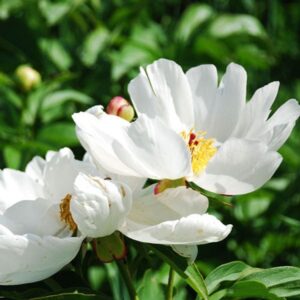
Some of the information below may not apply specifically to what we know in Britain as Common Peony, as the species has many variations, both in the wild and through wide cultivation. Descriptions from a range of medicinal traditions may also refer to other varieties, such as White Peony (Paeonia lactiflora), native to East Asia. Peer-reviewed scientific journals, used for some of this information, had contributors from the USA, China and India, among others.
Peonies were in use medicinally in China around 1000BC, and the practice spread to Japan, and much later to Europe. Peony is described as particularly useful in a number of women’s health issues including menstrual and menopausal symptoms and treatment for endometriosis.
Regarded as a ‘cooling’ plant, peony has been prescribed for many skin problems such as eczema and psoriasis, herpes and acne. It has also been suggested as a useful adjunct for control of epilepsy.
In all these applications the medicine is derived from the roots. Although the seeds have been described as “emetic or cathartic”, British herbalists writing in The Western Herbal Tradition, published in 2011, state: “There can be no recommendations whatsoever for use of seed without further research into their constituents”.
Myth and Magic
The name Peony is said to be derived from the ancient Greek Paeon or Paean, a deity mentioned in Homer’s Iliad as healing the warring gods. Later the word was applied to the physician Asclepius; and to the god Apollo who, through bringing death, also brought relief from pain. From the latter association, the word paean eventually became the name for a hymn of praise to Apollo, sung before battle.
Another story tells of Paeonia, a nymph. She was seduced by Apollo, thereby enraging the goddess Aphrodite. Depending on your point of view, Aphrodite either saved the nymph from his advances, or punished her for lack of resistance, by turning her into a flower. Some tellers embellish this story to suit their choice of peony: the nymph, conscious of her guilty passion, flushed deep red; or she was simply embarrassed, and coyly turned pink. Based on these suppositions, peonies are claimed, in various descriptions of the ‘language of flowers’, to represent either passion or bashfulness…
Two familiar names to visitors to our website are those of John Gerard (1545-1612) and Nicholas Culpeper (1616-1654), whose books on herbal medicine still fascinate the modern reader. Unsurprisingly, they each have something to say about Peony, which by their day was already familiar in British gardens.
Gerard relates a number of stories about the Peonie. He dismisses them as most vaine and frivolous; so you may enjoy reading a couple of them:
- The seeds shine in the night time like a candle.
- Rather than pick it yourself, tie a hungry dog to the plant at night, and hold out ‘roasted flesh’; so the dog, lured by the smell, will drag the plant up by the roots.
Culpeper writes about Peony, Male and Female. Was he describing two superficially look-alikes that were in fact two different plants altogether? Does his description reflect the variability of the peony species? It is not clear to me from his writing, nor from the wood-cut illustrations, in my modern copy of his book. He, however, is very clear: he writes that although physicians claim the male peony root is best, he recommends the male peony for men, the female peony for women.
The resilience of the flower is described in a Chinese legend about the powerful Empress Wu. What the empress wanted, she generally got, and what she wanted was a garden where the flowers blossomed all year round. The peony was the only flower that refused to bloom out of season, and in her rage she banished all peonies from the royal garden. However, the peonies bloomed beautifully in Luoyang, their place of exile, and the further enraged empress had all the plants burned. Yet, from the blackened earth, next spring they rose and bloomed again, and the city is known to this day as the City of Peonies.
Acknowledgements Thanks to the following for much of this information
Image of Paeonia officinalis from www.rhs.org.uk
Image of Paeonia lactiflora from www.adiantumschool.com
My copies of:
Culpeper’s Herbal
The Encyclopedia of Herbs and Herbalism (1989, ed. Malcolm Stuart)