
This page is about the variety known as Chinese Rhubarb, Rheum palmatum.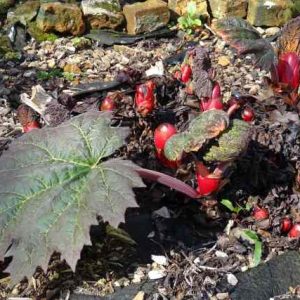
It is not the Rhubarb grown for cooking about which you can learn more here.
Rhubarb is native to China, and there are many different rhubarb species and hybrids. The root, not the stalks, of the medicinal plant was used for a range of remedies. This rhubarb’s properties are quite different from the sort used in cooking, and it had been a part of traditional medicine for thousands of years before Europeans heard of it.
In the early Middle Ages it began to be exported, along the Silk Road through Asia and the Middle East, into Turkey and Russia. For that reason, it is sometimes referred to as Turkey Rhubarb or Russian Rhubarb, as well as Giant Chinese Rhubarb. Explorers like Marco Polo were aware of it, and it finally reached Europe in the 14th century, as a very expensive medicinal drug, costing more than other prized herbs and spices such as cinnamon, opium or saffron. A 15thcentury Spanish ambassador to Samarkand on the Silk Road listed the best products from China: “ … silks, satins, musk, rubies, diamonds, pearls, and rhubarb…”
Rhubarb was not actually grown in Western Europe until the 16th century, according to records that mention planting in Italy. Further east, rhubarb was cultivated much earlier, especially in Russia along the river Volga, which has the ancient name Rha. The Latin word barbarum means ‘foreign’, and one theory is that from ‘foreign plant from the Volga region’ we get the common name rhubarb.
Medicinal use
There are many different rhubarb species and hybrids, and medicinal rhubarb, Rheum palmatum, also known as Giant Chinese Rhubarb, is the one used in herbal medicine: this is the rhubarb we grow in the Physic Garden. Our image shows the new shoots breaking through after winter.
Rhubarb is extensively used in traditional Chinese medicine, and modern medicinal herbalists recognise its properties. It has been prescribed:
- as a purgative in cases of constipation or bowel disorders
- as an astringent to stop bleeding in minor injuries
- as an analgesic for some cramps and pains
Recently, scientists have been studying the potential of various substances found in rhubarb for use in diabetes, cancer and other conditions, but research is at a very early stage.
WARNING – The leaves of rhubarb are very toxic from a high level of oxalic acid; but it’s safe to put them in your compost bin.
Acknowledgments – thanks to the following for some of the information above
www.rhubarbinfo.com
www.thekitchenproject.com
www.drugs.com
www.home-remedies-for-you.com