
On this page you will find information about the Blackcurrant, Ribes nigrum, its medicinal and other properties and place in folklore.
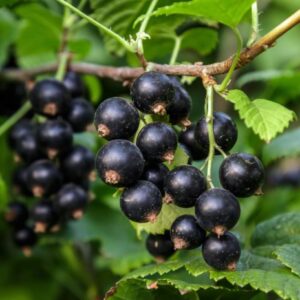
Blackcurrant is a hardy deciduous shrub, native to countries of the northern hemisphere, growing best where the winters are cold, as in Finland, Norway and Sweden where currant bushes are common not only in gardens but in the wild. In Britain it is not a native wild plant, but almost 5000 acres / 2000 hectares of our agricultural land are used for its commercial cultivation. It is also a relatively easy to grow garden fruit, and we have planted it alongside redcurrant and gooseberry bushes, members of the same plant family, in the Physic Garden in our Fruits for Health area.
The British climate is a good one for blackcurrants, as they thrive on a hard winter followed by a warm, sunny spring and summer but are tolerant of less ideal conditions. They suffer if the ground becomes water-logged, and do not usually do well in containers, but they will grow in any reasonably well-drained soil. They can be trained as a standard, or hard-pruned to create a multi-stemmed bush.
The flowers are small, easily overlooked by humans but attractive to pollinators, and the leaves are fragrant. Since, however, most people grow them to produce a crop of plump purple-black fruit, the ripening berries usually need protection from garden birds.
It is believed that blackcurrants were definitely familiar in Britain by the 17th century. John Gerard in the 16th century had written about a fruit that, by his description, seems to be a blackcurrant; but suggested that it was not often grown. He didn’t name it as blackcurrant, but in the same century Francis Bacon wrote about it using the word ‘coran‘, one of several similar spellings from which the modern name derives. The blackcurrant eventually became sufficiently well-established to be registered with the Royal Horticultural Society in 1826.
Blackcurrant fruits, unlike the red and white varieties which were seen as food, have a very strong and distinctive flavour, one herbalist even referring to the “somewhat loathing savour”of the fruit. Perhaps working on the theory that something that tasted so horrible (according to him!) must be good for you, many early writers described the plant only in medicinal terms; and one nickname for the plant was ‘squinancy berry’ after its use in treating quinsy (a complex form of tonsillitis).
Red and white currants were also established in North America, taken by the early settlers to Massachusetts and other north-eastern areas where they could thrive. The blackcurrant, however, has never been as well-known in the USA; and its cultivation there was banned for over a hundred years because of its part in spreading a deadly tree disease. White pine blister dust, caused by a fungus, is transmitted from pine tree via blackcurrant to pine tree. As pine trees are the main species for the extremely important US logging industry, the US forestry authorities have used the ban as part of their continuing work to eradicate the disease. Recent scientific advances in plant disease knowledge have enabled some states to overturn the ban, but there are still relatively few Americans who have seen or tasted blackcurrants in any form.
Medicinal Uses
Only in the 20thcentury was blackcurrant’s contribution to health officially recognised, when a blackcurrant drink (a cordial or squash to be diluted), invented by Dr Vernon Charley in 1938, was sold as ‘The Natural Health Drink of Our Time‘. The drink was called Ribena, and so healthy was it, being full of vitamin C, that the British government distributed it free to children and pregnant women during World War II. Ribena is still being produced and 90% of Britain’s commercial blackcurrant crop is given over to its manufacture.
Though vitamin C is a significant component, and essential to good health, the blackcurrant contains other useful compounds including antioxidants. It is also rich in the flavonoids called anthocyanins, which, in addition to giving the fruit its distinctive colour, have been linked with a number of useful pharmacological actions. These include the capacity to lower blood pressure, improve visual acuity, reduce the reproduction of cancer cells, prevent diabetes and lower the risk of some of the harmful effects of cardiovascular disease. Anthocyanins are also reported to have anti-inflammatory and anti-bacterial properties.
In addition, anthocyanins are being explored for their use as phytoestrogens, i.e. plant extracts with beneficial oestrogenic properties, particularly helpful to post-menopausal women. Some cosmetic anti-ageing skin products use blackcurrant extracts, and researchers are examining other potential areas of interest.
The berry is the main source of medicinal applications, but leaves, flowers and roots have also been used. Current research into blackcurrant seed oil suggests the presence of a chemical known as GLA (gamma-linolenic acid) may be useful to the immune system.
Culinary Uses
Apart from the ubiquitous cordial, blackcurrants are popular in Britain as jam, jelly and pie-filling, and the French name of the berry is cassis, from which the liqueur is produced. While most people find the flavour too sharp, they can also be eaten raw.
Myth and Magic
The berries we know as blackcurrants are in no way related to the currants that we use in baking cakes – they, just like sultanas and raisins, are dried grapes. The word currant itself is derived from the name of the ancient Greek city Corinth, referring to a type of grape grown in that region.
Blackcurrants, like the related red and white ones, are native to northern Europe and were introduced to Britain much later than the many plants that were brought here by the Romans, for instance, that were absorbed into our culture over many previous centuries. They were therefore named for their appearance: if it looked like a currant, they called it a currant. Actually, in those early English writings it was called a corinthe, or a coran, or variations on that theme; but then spelling was down to personal preference at that time.
I have been unable to find much folklore that is specifically about the blackcurrant: though one source describes an Iranian creation myth that has the first two humans born from a blackcurrant bush. The Norwegian word for blackcurrant, solbær, translates literally as sun-berry, perhaps a nod to the short summer season when it ripens.
Acknowledgments – thanks to the following for much information
www.healthline.com
www.blackcurrantfoundation.co.uk
www.saga.co.uk
www.webmd.com
www.gardenfocused.co.uk
www.ribena.co.uk
www.bbcgoodfood.co.uk
www.chathamapples.com
www.indielee.com
www.rhs.org.uk
www.ncbi.nlm.nih.gov/