Here you can read about Dark Mullein,Verbascum nigrum, its medicinal properties and place in folklore.
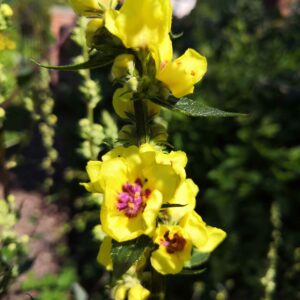
Dark, or black, mullein is a striking upright plant that can reach 1.2m in height. A biennial, the plant is seen firstly as a rosette of dark green, slightly heart-shaped leaves which have hairy undersides. In the second year, the single vertical flower stem rises from the rosette, in a spike bearing a multitude of rich yellow flowers from June to September or even later.
As a wild flower, its preferred habitats include hedge banks, road verges and grassy areas of disturbed ground. An excellent source of pollen and nectar for insects, it also produces masses of small seeds that attract small birds such as goldfinches.
Also known as black-rooted mullein, dark mullein is the second most frequently seen wild verbascum in Britain. The first is Great Mullein, (Verbascum thapsus): it is also tall but with paler yellow blooms, and the whole plant is rather ‘woolly’ to the touch. Dark Mullein is also distinguished by the purple, hairy stamens prominently visible in the centre of each bloom.
A wide variety of Mulleins, both wild and cultivated, with different coloured blooms, are to be found in many gardens nowadays, as they add vertical decorative interest and are easily grown from seed. Indeed, they often self-seed and are also known to hybridise easily with other mulleins. Extracts from these plants are also used in medicinal processes, but they are not otherwise edible.
Please note that much of the following information refers to mulleins in general, rather than specifically to Dark Mullein.
Medicinal Uses
Most medicinal references are to Verbascum thapsus, Great Mullein, but I mention them here as I have found no indication that these attributes do not also apply to others in the family.
Herbal medicines derived from mullein have been used to treat respiratory complaints including coughs and throat problems, bronchitis and asthma. The fresh or dried flowers can be steeped in olive oil to produce a treatment for earache and skin complaints.
Mulleins, like many plants used in traditional medicine, are now known to contain useful compounds such as glycosides and saponins (a particular type of glycoside). These compounds are found in varying degrees in different plants, and also vary in their action within the body, but in general terms they are associated with the prevention of cardiovascular and respiratory diseases and cancer.
Other uses
Hygiene
It has been stated that Great Mullein is sometimes known as the Andrex plant, its downy leaves being a useful alternative to toilet paper when camping in the wild… I cannot vouch for its efficacy.
Myth and Magic
Mulleins probably derive their common name from the Latin mollis, meaning soft, as many have velvety or downy leaves and stems. Verbascum, the name given by Linnaeus when classifying plants in the 18thcentury, is believed to be a corruption of Barbascum, from the Latin barba, beard, also referring to the hairy nature of this plant family.
In Britain, the common mullein was apparently formerly known in some areas as the candlewick plant, or hag’s taper (meaning witch’s candle), and the stem dipped in fat was used as a light, said to ward off the magic spells of witches.
This interpretation of the name is mentioned by Mrs M Grieve, who wrote in the 1930s A Modern Herbal, which is widely referred to (and even quoted verbatim without acknowledgment) by many botanical / herbal / wildflower / plant-lore websites. It contains many fascinating facts (as well as fictions). She doesn’t always identify her sources, and some of the science at least has become outdated over the past 90 years, but her writing is still relevant and entertaining.
Mrs Grieve also pointed out, with back up from the writings of several earlier herbalists such as Henry Lyte and John Gerard, that the name may in fact mean Hedge Taper, and nothing to do with witches. Hag, in this context, is likely to be derived from the Saxon word, haege, meaning Hedge; and the tall yellow spikes of mullein along the hedgerow could indeed look like points of light, as suggested by yet another common name, Our Lady’s Candle.
Acknowledgements Thanks to the following for much of the information above
wildflower finder.org.uk
www.wildseed.co.uk
www.naturespot.orguk
www.pfaf.org
www.gardenerspath.com
www.woodland-ways.co.uk
www.sciencedirect.com
www.botanical.com (Mrs Grieves – A Modern Herbal)