The Bath House was built circa 1820, with a minor late nineteenth century addition. It was in use by the occupants of Bradshaw House, as a private plunge pool, until the 1930’s. During the latter half of the twentieth century it fell into disrepair, and by the year 2000 was in a derelict state. Restoration of the building was completed by 2010, with the help of National Lottery Heritage Funding.
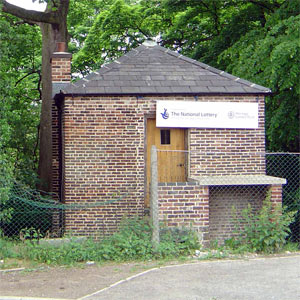
The building is fifteen and a half feet square and has just two rooms, one above the other. Each room has its own individual entrance door – there is no internal connection between them.
The plunge pool is in the lower of these two rooms and is sunk below ground level. It is stone lined and roughly nine feet square and six feet deep. Entrance to the water (the bath is empty at present) is by a stone staircase.

There are no windows in this lower room but evidence suggests that a bricked up area in one of the walls could at one time have been a window. The only light is admitted through the open doorway and through grilles in the walls. There is some evidence of a flue, which indicates that there could have been a stove to heat the room.
Water to fill the bath came from a nearby spring or stream, and two pipes visible in the walls of the bath appear to be the inlet and overflow pipes. In the early 19th century a water supply to the houses in Congleton was still many years away, so water from this same stream was piped to a cistern for Bradshaw House. This is shown on a 19th century ordnance survey map.
The entrance to the upper room is via a stone staircase built on the southern wall. This room is very pleasant and comfortable, with a fireplace and two large windows; one has an easterly aspect and the other looks over the garden to the north. The restoration has attempted to use the historic materials and techniques wherever possible, and the colours are based on fragments of paint found in situ.
On foot. 100 metres beyond Town Hall onto Lawton St. Turn first right onto Cole Hill Bank.
By Car. Parking at Back Park St CW12 1EP. Walk to Bank St. Right turn onto Lawton St and immediately turn left onto Cole Hill Bank.
Directions on Google Maps