
 Here is information about the Teasel, Dipsacus fullonum, its industrial and other uses and place in folklore.
The Teasel is native to Europe and Asia and found widely in the UK, particularly in grassland, waste ground and damp locations, and has also been introduced to North America where it is described in several US states as a Noxious Weed. As it produces great quantities of seed, it is certainly potentially invasive in the UK garden, where it is otherwise regarded as a handsome architectural plant, growing over six feet / two metres in height, or as a lure for pollinating insects and seed-loving birds such as the goldfinch.
(NB Dipsacus sylvestris is also known as a botanical name for this plant).
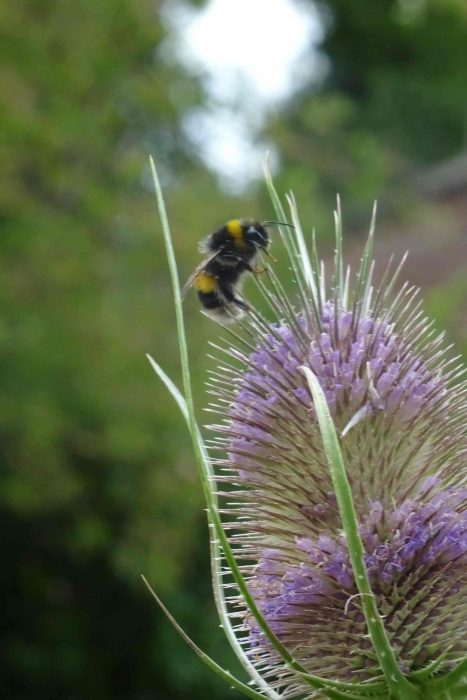
The image is of a bee visiting one of our teasel heads in the Physic Garden.
As a wildflower, its local names include Barber’s Brushes, Donkey’s Thistle, Fuller’s Teasel, Adam’s Flannel and Venus’s Basin. The latter name comes from the fact that the leaves are joined to the stalk in such a way that they create a ‘cup’ which holds rainwater. (The botanical name Dipsacus is derived from the Greek dipsa, meaning thirst).
The biennial teasel plant is covered entirely in thorns, even in the first year of growth when a rosette of spiny leaves develops, close to the ground. From the rosette, in the second year, a single thorny stalk grows, branching into many stems bearing flower heads. These resemble oval ‘pompoms’ on sight, but not to the touch!
The flowering habit of the teasel is very unusual. From about July, tiny purple blooms (or sometimes white) appear from the middle of the pompom, widening in rings towards the top and base. As new blooms open, the earlier blooms die off, with the result that two separate swathes of colour gradually make their way to the extremities of the flower head.
Once the blooms have all died the plant sets seed and gradually dries out. If left alone, its brown, prickly skeleton remains upright all winter to feed small birds and add a touch of drama to the winter scene. The seed heads are also used for their impact by flower arrangers – wearing gloves, we hope, as the thorns are persistent on all parts of the plant.
Any gardener looking for free plants only has to plant a teasel: come spring, there will be an abundance of spiky babies all around, in cracks between paving, under floppy rhubarb and hellebore leaves, masquerading as desirable cut-flowers in the border…
Industrial Uses
The teasel’s main claim to fame in the annals of useful plants is in the textile industry. The seed heads have been used for centuries to tease – or card – the fibres before spinning, cleaning out the debris and helping to run the fibres true. They were also used to raise the nap on woven cloth. Teasels were cultivated specifically for their role in textile manufacture, and were employed on an industrial scale well into the 19th and even early 20thcenturies.
Some craftspeople working by hand still prefer to use teasel heads, rather than metal combs, because the small hooked spikes are not as likely to tear fine fabric if they catch on an obstruction. Teasel is also still used to produce the ultra-fine finish on some hats and the baize for billiard tables.
Teasel can also produce a natural blue dye, similar to indigo, or yellow if alum is used as a mordant.
Medicinal Uses
Most internet references to the medicinal uses of teasel are vague and unsubstantiated, many quoting verbatim the same recognisable source without acknowledgment. There does, however, appear to be a history of folk medicine using teasel root preparations in the treatment of skin conditions such as warts, whitlows and acne – for instance, Culpeper quotes Dioscorides in this respect. It is also said that an infusion could strengthen the stomach and increase appetite.
An American blog (2010-2011) describes making teasel flower essence and teasel root tincture as ‘an ally’ in treating / living with Lyme Disease. I have also found a UK homeopathic company with teasel listed on their database.
Acknowledgments – thanks to the following for much information:
www.rhs.org.uk
www.plantlife.org.uk
www.turfonline.co.uk
www.pfaf.org
www.wildlifetrusts.org
www.helios.co.uk
www.ladybarbarasgarden.wordpress.com