
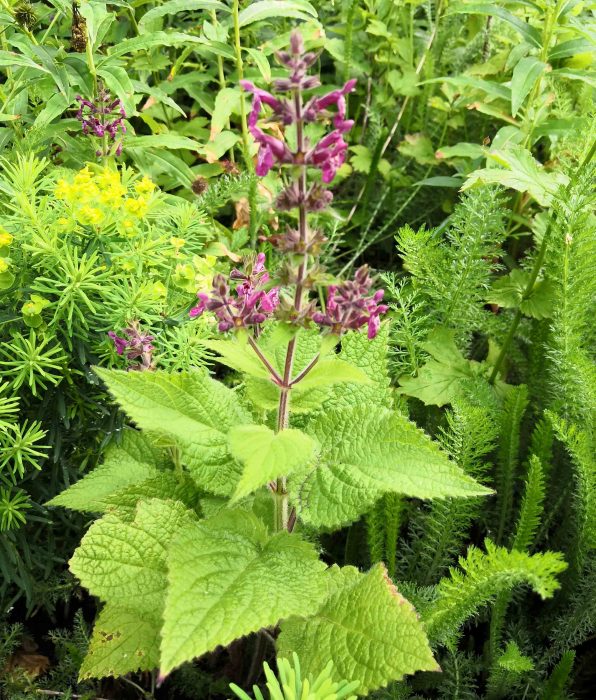
Hedge Woundwort is a native British wildflower found both in woodland and along hedgerows and roadsides. It belongs to the huge Lamiaceae (Deadnettle or Mint) plant family, along with many other species of edible and/or medicinal herbs. It is superficially similar to another wildflower, the Red Dead-nettle (Lamium purpureum – illustrated below), which also has ‘hooded’ flowers growing in whorls around the stem, though the flowers of Hedge Woundwort are a much darker hue. They are described by different sources as being beetroot-coloured, magenta, dark pink, or purple, and are ‘blotched’ with white. Apart from the flower petals, the whole plant, including its heart-shaped leaves, is somewhat hairy.
The plant is in bloom from early summer through to the autumn, and spreads by seed, or via underground rhizomes. It is attractive to pollinators, and is a particular choice for the fork-tailed bee.
Although a common wildflower in the UK, Hedge Woundwort is easily overlooked, its blooms often half-hidden among the longer grasses of its habitat. Its most distinguishing feature is perhaps the rather unpleasant smell emanating when its leaves are crushed. This odour is described by some as ‘mousy’, by others as ‘medicinal’; and another source states it is ‘repugnant to most but a few individuals’.
There are many common names for this plant, which you can see in our Myth and Magic section. For simplicity, we shall use Hedge Woundwort. That is the one that explains why you can find this wildflower in the Physic Garden: it has a long history of being efficacious in wound healing.
Medicinal Properties
Long used in poultices to staunch bleeding wounds, Hedge Woundwort also has antiseptic properties which help reduce or eliminate infection.
Modern science has been able to differentiate between the beneficial compounds of plants that have been traditionally used in medicine. Some of those found in Hedge Woundwort are reasonably familiar, seen on ingredient lists of many foodstuffs: amino acids, fatty acids, essential oils, flavonoids, etc.
More recent scientific investigations has determined that plants have naturally occurring defences, known as phytochemicals, that can contribute to human health too. It is the quantity and quality of these that make a plant more or less successful in herbal medicine.
Stachys is a large genus in the family Lamiaceae, containing around 300 species. There has been recent scientific research to differentiate between species, and not all of them have medicinal potential. However, researchers have determined that Hedge Woundwort contains some of the most useful chemical compounds. These include anti-oxidant, anti-inflammatory, antibacterial and anti-microbial properties; and some scholarly articles suggest further research may find medicinal potential beyond the historic use of these plants.
Myth and Magic
Wort is a suffix in many plant names. The word itself comes from the old English term ‘wyrt’that originally meant plant, or herb. It came to refer to plants that were considered beneficial. Examples are Lungwort and Bladderwort: it was believed they could heal diseases of those organs. Those plants thought not to be beneficial often have weed as part of their name: Ragweed and Knotweed, for instance.
John Gerard, the 16th century botanist and physician, described the plant in his Herball as Clown’s or Husbandman’s Woundwort. Husbandman was another name for farmer or farm worker, a trade with many opportunities to wound oneself, and thus a practical name for a suitable herbal remedy.
The other name was his own invention. In his Herball, he describes an incident in which a man seriously injured himself with a scythe. The man (perhaps a husbandman?) applied a poultice of woundwort to the gash. Gerard, a professional surgeon, offered to treat it ‘for charity’ (i.e. out of kindness, not for a fee). However, the man refused, saying Gerard’s methods wouldn’t heal it any better than his own. Gerard, his professional pride taking a knock, wrote that it was ‘a clownish answer, I confesse, without any thankes for my goodwill; whereupon I have named it Clownes Wound-wort…’
Woundwort, All-Heal, Self-Heal, and Heal-All were common names for many healing herbs, and might be locally attributed to different plants in different regions.
During my research, I found a considerable list of other names attributed to this herb. They include White Spot, Hedge Nettle, Grass Nettle, Hedge Stachys, Wild Nettle Grass, Archangel, Red Archangel, and Wood Betony.
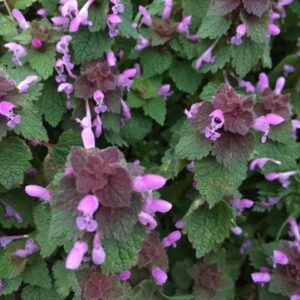
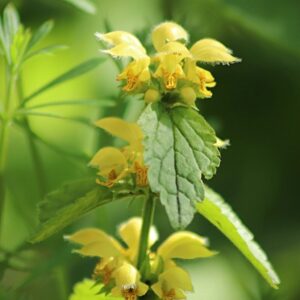
However, Archangel is the common name for types of dead-nettle; and (Wood) Betony is the usual term for a close relative of woundwort, formerly Stachys officinalis, now Betonica officinalis. See our page on Betony.
These English names have been applied to superficially similar plants in different parts of the UK from medieval times. The relatively late classification of plant species has also naturally led to some overlap (or confusion) in allocating names to specific plants. Sometimes we need to fall back on botanical Latin!
Acknowledgements – thanks to the following for much of this information
https://philipstrange.wordpress.com