
Read here about Blackthorn, Prunus spinosa, its medicinal and other uses and place in folklore.
Blackthorn, also known as Wild Plum or Sloe Plum, is native to the British Isles and most of Europe, and is the ancestor of many delicious cultivated plums. Found in hedgerows all through the UK, it is one of the earliest trees to flower, sometimes as early as March, with an abundance of white blooms on its bare branches before the leaves appear. 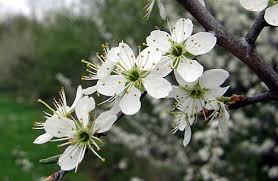
Sometimes mistaken for Hawthorn, this early leafless blossom is the major visible distinction between the trees. Its name is true, too – it has long, needle-sharp black thorns along the twigs. Later in the year, blue black fruits, called sloes, appear. The tree is a haven for wildlife; and in particular is the chosen food for the caterpillar of the rare Black Hairstreak butterfly.
WARNING: although sloes are definitely edible they are extremely bitter in their natural state; and a wound from the thorns can quickly become septic if not cleaned properly.
Medicinal Uses
Blackthorn has been utilised for centuries to treat a wide variety of ailments, and modern science has found evidence to support the folklore. The bitterness of the bark is now known to be the result of its high tannin content, and the flowers have been found to contain anti-inflammatory and other useful flavonoids.
Medicinal preparations made from blackthorn include:
– infusions of the flowers as a laxative and as a diuretic
– juice from the fruits, or flower infusions, as an anti-inflammatory
– a paste made from the fruits to remove tartar from teeth
– extracts from the bark as an astringent
– decoction of the bark to bring down fever
Culinary Uses
As an ingredient, blackthorn fruit usually ends up as sloe gin, but it can also be used to flavour vodka and cocktails, or made into a non-alcoholic syrup. It can also be used in place of the more usual plum in a variety of recipes, including jellies, jams and desserts. But as it has a large amount of stone to flesh, and needs a great deal of sweetening, this may explain why it isn’t the cook’s first choice.
Other Uses
Blackthorn has provided us with useful products over many centuries. The long sharp thorns make it an obvious choice for hedges to keep animals in – or out; the bark and fruits can be used to make ink and dyes for cloth; and the branches make excellent walking sticks – it was the wood of choice for the Irish shillelagh, for instance.
Myth and magic
The blackthorn had a reputation in the Middle Ages as a tree of ill-omen, (possibly because of its sour-tasting fruit and vicious spines?), and was associated with witchcraft and the devil: witches were burned on blackthorn pyres. The hedge that surrounded Sleeping Beauty was reputed to be of blackthorn. A blackthorn stick was supposed to ward off evil spirits, and it was the wood of choice for Irish walking sticks. Oddly, nowadays blackthorn sticks are used in military ceremonials!
Acknowledgments – Thanks for some of this information to:
www.woodlandtrust.org.uk
www.lollysmith.com
www.pharmaceutical-journal.com
www.naturescalendar.org (Visit their site for a free fact sheet)