
Here you will find information about the Blackberry or Bramble, Rubus fruticosus, its medicinal and other properties and its place in folklore.
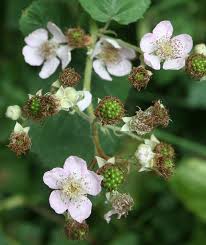 Our native Bramble is also found in most temperate parts of Europe, West Asia, and North Africa; and has now been naturalised in America and Australia. Richard Mabey offers two alternative local names from the UK: Blegs, and Black Heg. The wild plant has long arching stems, up to two or more metres long, and both stems and leaves have many thorns, or prickles. The clusters of white or pink five-petalled flowers appear on mature branches from late spring onwards, and the fruits – known as blackberries – ripen through red to reach their familiar near-black in late July or August. Blackberry-picking is probably one of the last foraging activities that is still commonly practised by ordinary families; and in popular art, and on cards and calendars, the fruit is to autumn what daffodils are to spring.
The flowers attract honey bees, bumblebees, and other insects, while the leaves are a food source for some caterpillars and such animals as can cope with the prickles. The berries are eaten by small birds and several mammals, including fox and badger, and the plant makes a protective habitat for grass snakes and other small animals. The fruits are technically not berries, which are fruits developed from one ovary (oddly, the banana is one such). The bramble flower has many ovaries and, like raspberries and strawberries, the blackberry is ‘an aggregate fruit’, made up of ‘multiple drupelets’. We’ll not be changing its name any time soon, however.
A member of the Rosaceae family, the bramble is a familiar hedgerow plant, also thriving in woodland and on wasteland and derelict sites. Flowering branches live for about three years, dying back after the last year’s fruit, but one plant can colonise an area quickly by producing ‘runners’, stems that develop roots as soon as they reach the ground.
Brambles can also germinate seeds without being pollinated, and this has led to the development of many subtly different ‘micro-species’ – over 300 have been identified, just in the British Isles. Difficult even for botanists to tell one from another, they are generally referred to as the Rubus fruticosus aggregate. To add to the confusion, and the proliferation of these micro-species, they also hybridise easily.
This multitude of species, as far as the non-botanist is concerned, merely means that different plants produce different amounts of fruit; that their berries may taste slightly more – or less – acidic, or sweet; that the fruit are larger, or smaller, or a slightly different shape. Most of the minute differences are unnoticeable to the casual blackberry-picker.
There are several cultivars available for gardeners and commercial growers, developed to reduce or eliminate the thorns, and to produce larger, sweeter and more consistent fruit. These cultivars are also easier to control than the sprawling wild plant, and can be trained over arches and fences, and some can even be grown in pots.
Botanists who specialise in studying the Bramble are known as batologists, from the Greek word for blackberry: ‘vatomourias’ (βατομουριάς). One such enthusiast was local poet and botanist J. B. L. Warren, 3rd Baron de Tabley, whose book The Flora of Cheshire was published after his death. His grave in St Oswald’s churchyard, Lower Peover, has a stylised carving of a bramble on the headstone.
Medicinal Uses
The bramble has long been used in traditional medicine, with its cleansing and antiseptic properties proving useful in the treatment of wounds, inflammation and fever. It was also used as a remedy for colds and coughs.
In general, the leaves and roots are the parts used medicinally, although the fruits contain a high concentration of Vitamin C and are thus helpful in supporting the natural health of the body.
The leaves and roots have been used to treat diseases of the digestive tract such as dysentery and gastro-enteritis, being astringent and purgative. The astringent property of the leaves was recommended by ancient physicians and writers including Hippocrates, Dioscorides and Pliny. Culpeper claimed that most parts of the plant had strong healing properties, including that “The powder of the leaves strewed on cancers and running ulcers does wonderfully help to heal them”.
The fruit and leaves contain many useful compounds, including sugars and tannins, pectin, flavonoids, carotenoids and saponins, and traces of essential oil. The fruit contains several B vitamins as well as being a good source of Vitamin C, approximately 15mg per 100g.
Culinary Uses
A Neolithic man excavated in Essex was found to have eaten blackberries, so they have clearly been a food source for thousands of years. Blackberries, perfectly edible raw as well as cooked, are often thought too tart to be eaten without a sweetening accompaniment, often another fruit, especially that other autumn staple, the apple. Whether for pies and puddings, jams, jellies and vinegars, or alcoholic and non-alcoholic beverages, it is a home-grown culinary treasure.
In the 18th and 19th centuries a strong ale was brewed that added blackberries to the usual malt and hops (and a 21st century gin that included blackberries with the other botanicals was a successful idea, in this writer’s view).
Forensic Uses
Because of their habitat and growth patterns, brambles are useful to forensic botanists. Brambles can be helpful in establishing, at a crime scene, the length of time human remains have been in that place.
Domestic and Agricultural uses
In ancient times, the tough stems of the bramble were used for basket making, for thatching, and for making beehives. Fibres derived from the stems could also be used to make a type of rope.
In some areas, brambles were planted deliberately to prevent deer grazing on young tree saplings and other plants. Brambles are also useful in preventing soil erosion.
Perhaps most obviously, brambles are a convenient, easily-grown and impenetrable barrier along fields and other boundaries, the natural precursor to – and possibly inspiration for – barbed wire.
Myth and Magic
British folklore has it that blackberries should be avoided after Old Michaelmas Day (29thOctober) as the Devil, passing by, spits on them, in revenge for having landed in a bramble bush when he was thrown out of heaven by St Michael the Archangel on that day. The legend is a cautionary tale against picking late fruit, as the berries by this time of year tend to be small, acidic and often mildewed.
When I was a child in Yorkshire we were warned not to pick the fruit from the lower branches as they could be polluted by dogs, or other passing animals. No one mentioned the devil…
Brambles were sometimes planted on graves: whether to prevent sheep grazing in the churchyard, to prevent the devil interfering, or to ensure the dead stayed buried is not clear. One story related by Richard Mabey tells of a man who sat up in his coffin when the bearers, stumbling on stones in the lane, had accidentally dropped him en route to his burial. He lived for some time after, even getting married again, and left money in his will for the lane to be swept clear of stones once a year, and for brambles to be laid on top of his grave ‘to keep off the sheep’.
It was once believed that if people were suffering from rickets, whooping cough, rheumatism or a hernia, being taken through a loop of bramble would cure them.
In Scottish Gaelic, the plant is known as An dris-mhuire beannaichte, (the blessed bramble). It was hung above the lintels of cattle sheds along with lengths of ivy and rowan branches, perhaps as a physical barrier just as the ivy and rowan were designed as mystical protection.
Scottish folklore also interprets a dream, in which you are passing through an arch of bramble. If the thorns prick you, there will be trouble in the family, and if they draw blood your business will suffer. However, if you get through unscathed, you will triumph over your enemies.
Acknowledgments – thanks to the following for much information
Gardenersworld.com
Woodlandtrust.org.uk
Herbaria.plants.ox.ac.uk
Eatweeds.co.uk
Bbc.co.uk
Ecoenchantments.co.uk
Weewhitehoose.co.uk
Historic-uk.com