
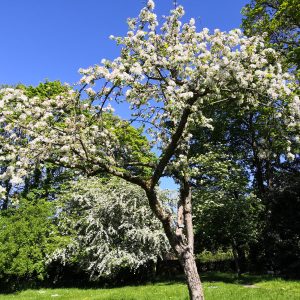
On this page you will find information about the cultivated Apple, Malus domestica, its medicinal properties, other uses and its place in folklore. The image is of our single old apple tree in the Physic Garden.
The modern apple, available in thousands of cultivars, in colours ranging from pale yellow through bright green to deepest red, with a taste that ranges from very sweet to acidic and tangy, is a member of the plant family Rosaceae. This family includes a number of fruiting trees, including almond, pear, and peach; thorny shrubs like cotoneaster, brambles, raspberries, hawthorn and, of course, roses; and flowering plants such as lady’s mantle, burnet and goatsbeard. Apples might be considered the most familiar fruit in the modern world, but those we see today are the result of centuries, if not millennia, of development from their wild origins in Eastern Europe and Asia, and genetic studies show that modern apples derive from at least four different original sources.*
Our attractive old Apple tree was once one of a pair, framing the garden shelter. We believe the variety to be Lane’s Prince Albert, a cooking apple that was discovered in the 1840s. The pretty pink and white blossom appears before the leaves and attracts early pollinators, and the tree offers some shelter during warmer weather as well as being of benefit to birds and insects. Apple trees grow best in a sheltered, sunny spot, enabling the sun to ripen the fruit.
Apples provide a tasty addition to a healthy diet, and there are other medicinal benefits to be found as we describe below. Growing your own is also now very possible, with specially grafted trees being developed that can flourish in pots, be trained against a wall, or grow as a low, step-over ‘hedge’. For start-up advice for the home gardener, try the RHS downloadable chart Growing Apple Trees.
Modern supermarkets sell only a limited range of commercially produced apples, so that many people don’t realise how many other types can be found, and easily grown. Most ancient orchards in Britain, such as those in Somerset and Herefordshire, have been destroyed or allowed to fall into disuse, but happily there is now a drive to save as many of these, and their varieties of ‘heritage’ fruit as possible. There is plenty of information on the internet, including here.
*Further theories about the history of the modern apple can be found in an article by Robert Spengler of the Max Planck Institute for the Science of Human History. He suggests how trade along what we now call the Silk Road played a part in this development.
Medicinal Uses
The adage ‘an apple a day keeps the doctor away’ isn’t as old-fashioned as it may seem: apples contain many compounds of benefits to human health, including fibre, pectin, vitamins, minerals and proteins. The bark contains substances that can reduce fever and aid sleep, and the leaves have antibacterial properties.
Traditional Ayurvedic medicine recommends eating apples to cut down risks of heart disease, type 2 diabetes, and cancer, as well as encouraging healthy digestion. Modern science concurs, and also agrees that benefits are enhanced by eating the peel rather than removing it. Flesh and peel have a potent antioxidant activity that can protect against the onset and growth of a number of cancers.
Pectin, mostly found in the peel, is known to reduce levels of cholesterol, but also aids moderation in our diet as it delays hunger pangs. Similarly, the fibre in the apple and its skin are beneficial in keeping a healthy gut and preventing constipation.
The high level of the chemical compounds known as polyphenols makes eating apples as part of a routine diet an easy way to reduce the risk of developing asthma and stimulate lung health. As polyphenols are able to influence the intake of glucose, apples also help to lower the risk of diabetes-related complications.
WARNING: apple seeds contain small amounts of cyanide, so should not be eaten in large quantities.
Other Uses
The apple is of course a basic ingredient for any cook, but is also produced for cider: the orchards of the South West of England were largely developed for this purpose, though only a few still remain.
The shape of the apple is a frequent design feature, and the Beatles and Steve Jobs could testify to its power as a name and logo. But that fascinating story is for another place!
Myth and Magic
Apples appear in stories from around the world, from ancient times, but we try to keep in mind that ‘apple’ is possibly a generic name for any local fruit-bearing tree. As we found out in our research into the Common Quince, it is possible that mistranslation has put the apple in an unfairly prominent place, especially in those regions of the world where quinces, or other fruit trees, were far more common. Quince fruit are golden, so we offer you that alternative where the colour is specified – but we know that Snow White ate a red one, so definitely not a quince in that story!
In Irish myth, Connla of the Red Hair was given an apple by a beautiful fairy maiden. This apple became whole again after it had been eaten, and Connla, pining for the fairy, lived on nothing but the one apple for a whole month. When she returned, he went with her to an island in the Otherworld, where the trees bore a never-ending supply of the apples.
The Welsh collection of legends, the Mabinogion, has a tale about King Bran the Blessed, who on waking one day found a silver branch bearing apples. The branch being spirited away by – you guessed – a beautiful fairy woman singing an enchanting song, he vowed immediately to recover them, and set off on a lifelong voyage of adventure.
The name of Avalon, the resting place of King Arthur, is thought to mean Island of Apples. This meaning is found in three Celtic languages: WelshYnys Afallon; in Cornish Enys Avalow; in Breton Enez aval.
In a Norse myth, the goddess Idun, keeper of the apples of immortality, food of the gods, was snatched away from Asgard, home of the gods, causing the gods to grow old, and they did not regain their youth until the goddess and the apples were finally returned.The ancient Celts also associated apples with death and rebirth, and it is believed they buried apples in graves as food for the dead: petrified remains of sliced apple have been found in tombs in Europe and West Asia, dating back to 5,000 BC.
Acknowledgements – thanks to the following for much of this information
www.gardenersworld.com
www.eldrum.co.uk
www.ayurtimes.com
www.sciencedirect.com
www.nature-and-garden.com
www.sciencedaily.com
www.ireland-calling.com
www.appleharvester.blogspot.com
www.alimentarium.org