
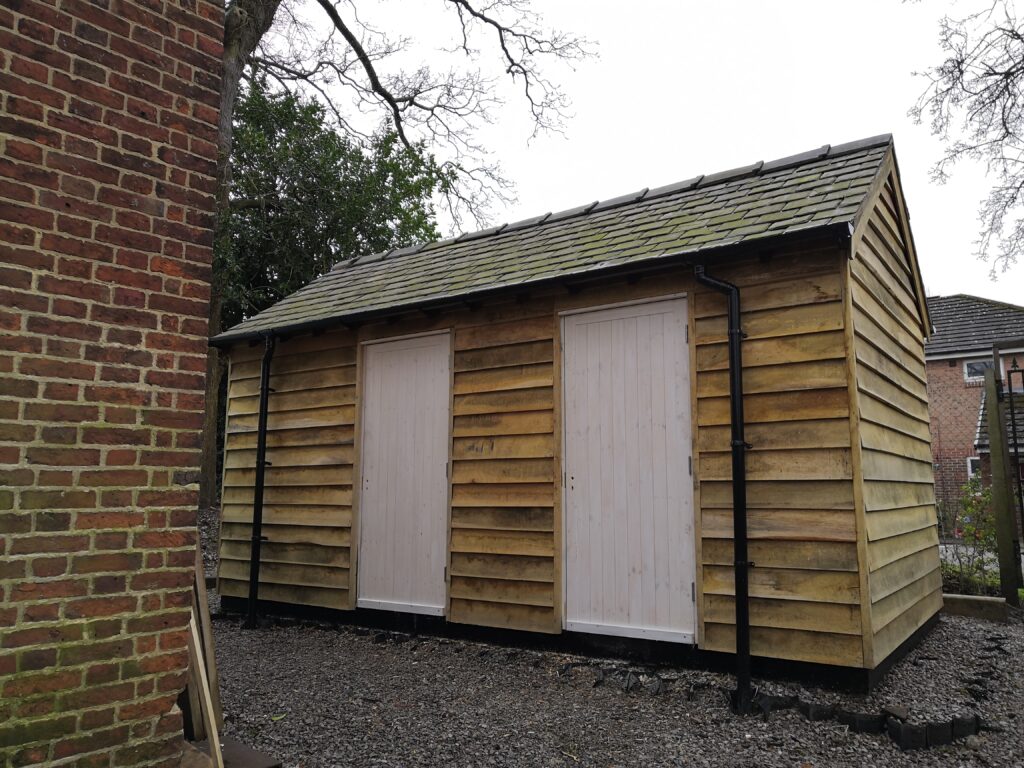
With the structure and exterior of our new building for volunteers now complete, thoughts are turning to the fitting out of the inside. Grants from a number of local organisations have enabled us to get this far and generous grant awards from the William Dean Trust and the Inclosure Trust in recent weeks will mean that the project can be finished. We are very grateful for their support. Work has now begun on preparing and levelling the ground around the buildings so that gravel and stone paths can be created which will link in with the steps and path leading to the garden.
The garden begins to show the first stirrings of spring, with bulbs starting to break the surface of the woodland garden, and the Hamamelis covered with its spidery, fragrant flowers. Also known as Witch Hazel, our Hamamelis is related to the North American variety known for its usefulness in treating skin conditions.

There is plenty of work to do in the garden, clearing the previous year’s growth, cutting back and pruning. Gardeners are encouraged to pause from time to time, at the insistence of the robin, who needs to inspect their work for loose worms. The robins are always particularly attentive at this lean time of year.
Work on preparing the wildflower meadow has been suspended. Alternating rain, frost and snow has left it rather waterlogged, and we shall let it dry out a bit before walking on it. We have, however, scattered some seed gathered from a couple of interesting plant varieties found in local wild areas. Red Bartsia (Odontites verna) is related to Yellow Rattle, and is also parasitic on the roots of grass, helping to suppress the dominance of grass in a meadow. It has toothed leaves (leading to its use by Pliny the Elder to treat toothache) and pink flowers.
The other recent discovery is Centaury (Centaurium erythraea), a small, overlooked plant with star shaped pink flowers. It is named after Chiron the centaur, ancient healer in Greek mythology, who used it for treating his wounds. According to Culpeper ‘It is singularly good both for green and fresh wounds, as also for old ulcers and sores, to close up the one and cleanse the other’. It likes dry, sandy grassland, so the current conditions are not ideal, but we shall watch that space with interest.